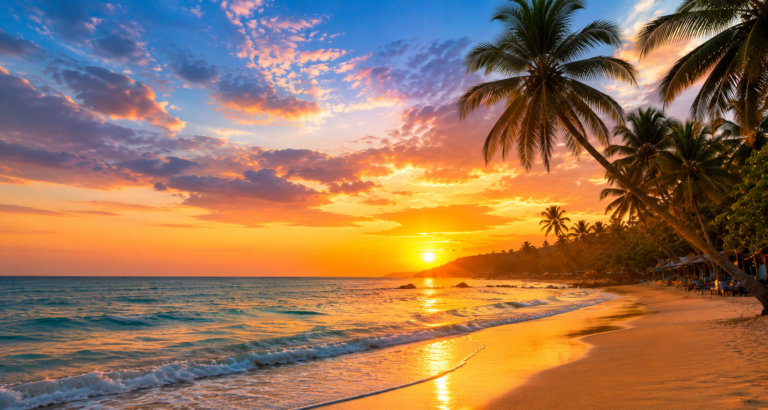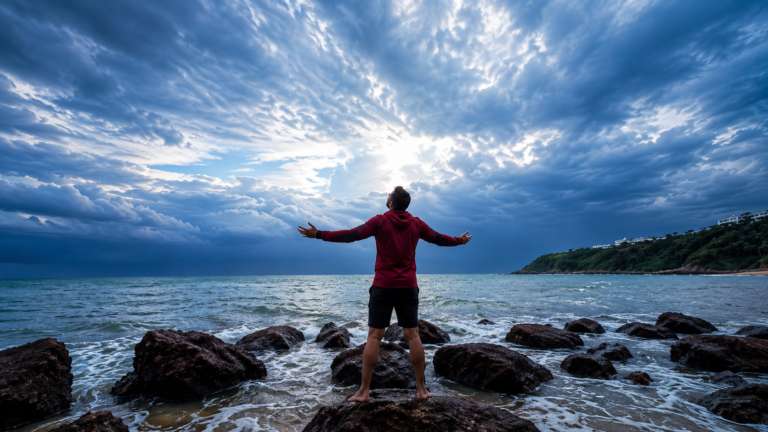
The Goa I Never Expected to Find
Whenever someone says “Goa,” most people imagine beach parties, loud music, expensive cafés, and crowded shacks.
That was exactly the picture I had in my mind before this trip.
Social media convinced me that Goa was all about nightlife. YouTube videos showed influencers hopping from one beach club to another. Travel reels made it seem like every day in Goa was a party.
I thought I already knew what to expect.
I was completely wrong.
The Goa I discovered was nothing like the one I had imagined.
It was waking up to the sound of rain instead of traffic.
It was riding a scooter through roads lined with coconut trees while dark monsoon clouds drifted overhead.
It was getting lost on unfamiliar roads and accidentally finding places that never appear in travel guides.
It was conversations with strangers who treated us like friends.
It was watching enormous waves crash against the shore while sitting silently on a beach with no agenda except enjoying the moment.
By the end of seven days, I realised Goa isn’t just one destination.
It’s many different places wrapped into one state.
North Goa is energetic and constantly moving.
South Goa is peaceful and almost meditative.
The cities tell stories of Portuguese history, while the villages show a completely different side of Goan life.
This guide isn’t based on internet research.
It’s based on every kilometre we travelled, every hotel we stayed in, every mistake we made, and every memorable conversation we had during our journey.
If you’re planning your own Goa trip, I hope this guide helps you avoid the mistakes we made while also encouraging you to discover the side of Goa that most travellers never talk about.
Why We Chose Goa
Our trip started with a simple question.
Where should we go next?
We considered several destinations.
Himachal Pradesh was one option.
Kerala was another.
Even Rajasthan was on the list for a while.
But one place kept returning to our conversations.
Goa.
There was just one problem.
It was the middle of the monsoon season.
Almost every travel article warned against visiting Goa during heavy rains.
Friends told us we’d spend the whole trip inside the hotel because it would rain continuously.
Others said many water sports would be closed and several beaches wouldn’t look their best.
For a moment, we almost changed our plans.
Looking back now, I’m incredibly glad we didn’t.
Yes, it rained almost every day.
Yes, the sea was rough.
Yes, some activities weren’t available.
But in return, we experienced a quieter, greener, and more peaceful Goa than most tourists ever get to see.
Hotels were cheaper.
Tourist crowds were smaller.
The roads looked stunning after every rainfall.
Instead of standing in long queues, we often had entire stretches of beach almost to ourselves.
Monsoon Goa wasn’t a compromise.
It became one of the highlights of the journey.
Planning the Trip
Once we decided on Goa, the next challenge was planning everything.
Like most travellers, our first instinct was to search online.
Thousands of articles claimed to offer the “perfect Goa itinerary.”
The problem was that almost all of them looked identical.
Visit Calangute.
Visit Baga.
Take a cruise.
Watch the sunset.
Repeat.
None of them explained how much things actually cost.
Very few discussed hotel experiences honestly.
Almost nobody talked about what could go wrong.
Instead of copying someone else’s itinerary, we decided to create our own.
We booked different hotels across multiple locations instead of staying in one place.
It meant packing our luggage more often, but it also allowed us to experience different sides of Goa.
Looking back, that decision completely transformed our trip.
Every hotel offered something unique.
Every neighbourhood had its own personality.
Instead of remembering one hotel for seven days, we now have memories attached to several different parts of Goa.
Our Goa Budget Plan
One thing we agreed on before leaving Delhi was that we wanted a comfortable trip without spending unnecessarily.
We weren’t trying to make it a luxury vacation.
At the same time, we didn’t want to compromise on comfort just to save a few hundred rupees.
Our rough budget looked something like this:
- Comfortable hotels instead of hostels.
- Local restaurants mixed with a few café visits.
- A scooter instead of taxis.
- Train travel instead of flights.
- Enough flexibility to enjoy experiences without worrying about every expense.
By the end of the trip, our total spending came to around ₹20,000–₹25,000 per person, which felt like excellent value considering everything we experienced.
I’ll break down every expense later in this guide.
Why We Chose the Train Instead of a Flight
Whenever I told people we were travelling from Delhi to Goa by train, the reaction was almost always the same.
“Thirty hours? Why not just take a flight?”
It was a fair question.
A flight would have taken only a few hours.
The train would take more than a full day.
But for us, travelling has never been only about reaching the destination.
The journey matters too.
There is something special about watching landscapes slowly change outside a train window.
Cities become towns.
Towns become villages.
The flat plains of North India gradually transform into the lush green hills of Maharashtra.
Air travel gets you somewhere quickly.
Train travel allows you to experience the distance between two places.
And sometimes, that’s where the best stories begin.
Boarding the Train in Delhi
The day of departure finally arrived.
Our bags were packed, hotel bookings were confirmed, train tickets were downloaded, and excitement had officially replaced all the planning stress.
As we reached the railway station in Delhi, the familiar chaos immediately surrounded us.
Porters hurried through the platforms carrying heavy luggage on their heads.
Families searched for their coaches.
Children pointed excitedly at passing trains.
Vendors moved through the crowd selling tea, coffee, samosas, water bottles, and snacks.
The station felt exactly as an Indian railway station should—busy, noisy, and full of life.
When our train slowly entered the platform, the reality finally sank in.
After weeks of planning, our Goa journey had officially begun.
The First Friends of the Journey
One of the best things about long train journeys is that you rarely remain strangers for very long.
A few hours after departure, we started talking to a family travelling from Delhi.
Like us, they loved travelling and had visited Goa multiple times.
When they learned it was our first extended trip there, they immediately began sharing recommendations.
Most of them weren’t famous tourist attractions.
Instead, they recommended practical things that only frequent visitors usually know—good places to stay, areas to avoid, and local tips that never appear in travel brochures.
One recommendation stood out.
They suggested we consider staying at Sea Sapphire, saying it offered good value for money and was conveniently located for exploring North Goa.
At that moment, we simply noted the suggestion.
We had no idea that recommendation would become the beginning of one of the best parts of our trip.
The Journey Was Already an Adventure
A 30-Hour Journey That Never Felt Too Long
People often ask me whether travelling by train for almost thirty hours becomes boring.
Surprisingly, it didn’t.
Long train journeys have a rhythm of their own. Unlike flights, where everything happens in a rush, train travel forces you to slow down. Hours pass differently. Conversations become longer, the scenery changes gradually, and before you realise it, you’ve travelled hundreds of kilometres.
That was exactly how our journey to Goa unfolded.
The first few hours were familiar. The landscape outside the window looked like North India—busy towns, endless fields, small railway stations, and the occasional group of children waving at passing trains.
As evening approached, passengers settled into their berths. Some watched movies, others played cards, and a few simply stared out of the window while listening to music.
It felt less like public transport and more like a temporary neighbourhood.
Meeting Abhinav – Advice That Actually Helped
The next morning, another interesting conversation began.
A young traveller named Abhinav joined us, and naturally, the topic shifted to Goa.
Unlike many people who only talked about beaches and nightlife, his first advice was completely different.
“Be careful while renting a scooter,” he said.
He explained that some rental shops try to charge tourists for scratches that were already there before the vehicle was rented.
He also warned us about overpriced taxi services and restaurants located right next to famous beaches.
His advice was simple.
“Take your time before agreeing to anything. Goa is amazing, but don’t let excitement make you careless.”
At the time, those suggestions sounded like ordinary travel advice.
Later, I realised they saved us from making a few expensive mistakes.
Whenever someone asks me for Goa tips now, this is one of the first things I tell them.
Maharashtra Changed Everything
If you’ve never travelled to Goa by train, one of the biggest surprises is how dramatically the scenery changes as you approach the Konkan region.
Somewhere after entering Maharashtra, I found myself looking out of the window almost continuously.
The dry landscape slowly disappeared.
Everything became greener.
The hills looked as if someone had painted them only a day earlier.
Waterfalls appeared beside the tracks.
Small rivers flowed through dense forests.
Tiny villages were surrounded by endless coconut and banana trees.
Because we were travelling during the monsoon, every colour looked richer.
The rain had washed away the dust, leaving behind an almost unreal landscape.
Several times, I reached for my phone to take photos.
A few minutes later, I stopped trying.
Some views simply cannot be captured properly through a train window.
They have to be experienced.
To this day, the Konkan Railway route remains one of the most beautiful train journeys I’ve taken in India.
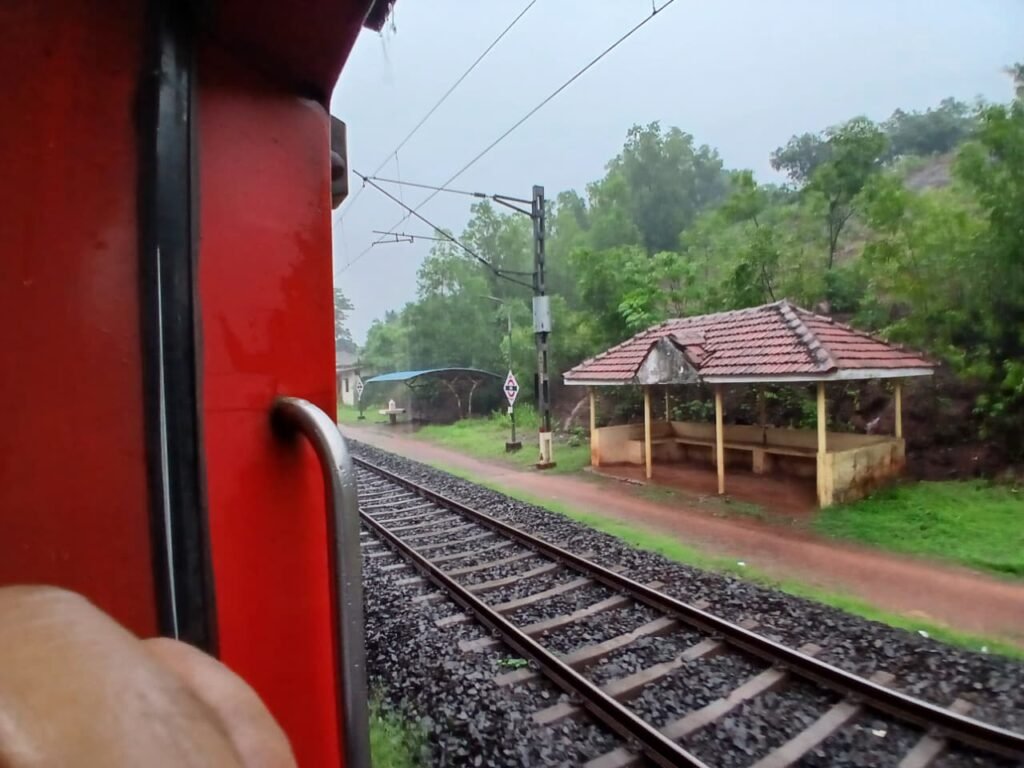
A photograph taken through the train window showing lush green hills and waterfalls during the monsoon.
Arriving in Goa… Almost
After more than a day on the train, excitement started building.
Every station announcement made us think,
“Maybe this is it.”
Our luggage was already packed.
Backpacks were ready.
Google Maps was open.
When the train finally approached Goa, we made one small mistake.
Our original plan had been to get off at Madgaon.
Instead, we got down at Thivim Railway Station.
For a few seconds, we simply looked at each other.
“Weren’t we supposed to get off later?”
Fortunately, it wasn’t a disaster.
In fact, it turned out to be a blessing.
Thivim was much closer to the area where we planned to stay in North Goa, and it saved us both time and money.
Sometimes the best travel decisions aren’t decisions at all.
They’re happy accidents.
First Impressions of Goa
The moment we stepped outside the station, one thing immediately stood out.
The air felt completely different.
It carried the smell of wet soil mixed with the salty breeze from the Arabian Sea.
After spending more than thirty hours inside a train, that first breath of fresh Goan air felt incredibly refreshing.
The roads looked cleaner than I had expected.
Palm trees lined both sides of the streets.
Scooters outnumbered cars.
Even the pace of life seemed slower.
Nobody appeared to be in a hurry.
That calm atmosphere stayed with us throughout the trip.
The Search for a Scooter
If there is one thing I recommend to almost everyone visiting Goa, it’s this:
Rent a scooter.
Before arriving, I had considered using taxis for the entire trip.
Thankfully, I changed my mind.
Without a scooter, we would have spent thousands of rupees on transportation alone.
More importantly, we would have missed many places that weren’t easily accessible by taxi.
After comparing a few rental shops, we finally found one offering a reasonable deal.
The owner quoted us ₹500 per day, with a refundable ₹2,000 security deposit.
We inspected the scooter carefully before accepting it.
Thanks to Abhinav’s advice, we took photos and videos of every scratch, dent, and minor mark on the vehicle.
The shop owner smiled and said,
“Most tourists don’t do this.”
Maybe not.
But it gave us peace of mind for the rest of the trip.
That scooter would become our companion for the next seven days.
It carried us through rainstorms, beach roads, quiet villages, and countless wrong turns.
Looking back, renting it was probably the best decision we made.
Riding Through Goa for the First Time
As soon as we started riding, I realised something.
Driving in Goa feels completely different from driving in Delhi.
There was less honking.
Less aggressive traffic.
Vehicles moved at a more relaxed pace.
People actually stopped to let others pass.
Within just a few kilometres, I found myself enjoying the ride instead of concentrating only on the traffic.
The roads curved through coconut groves, colourful Portuguese-style houses, and small roadside cafés.
Even though we hadn’t reached our hotel yet, it already felt like the vacation had begun.
Checking Into Sea Sapphire
Following the recommendation from the family we met on the train, we checked into Sea Sapphire.
The first impression was excellent.
The reception staff welcomed us warmly, the check-in process was quick, and within minutes we were in our room after nearly thirty hours of travelling.
The room was clean, spacious, and surprisingly comfortable for the price we had paid.
But the biggest surprise came later.
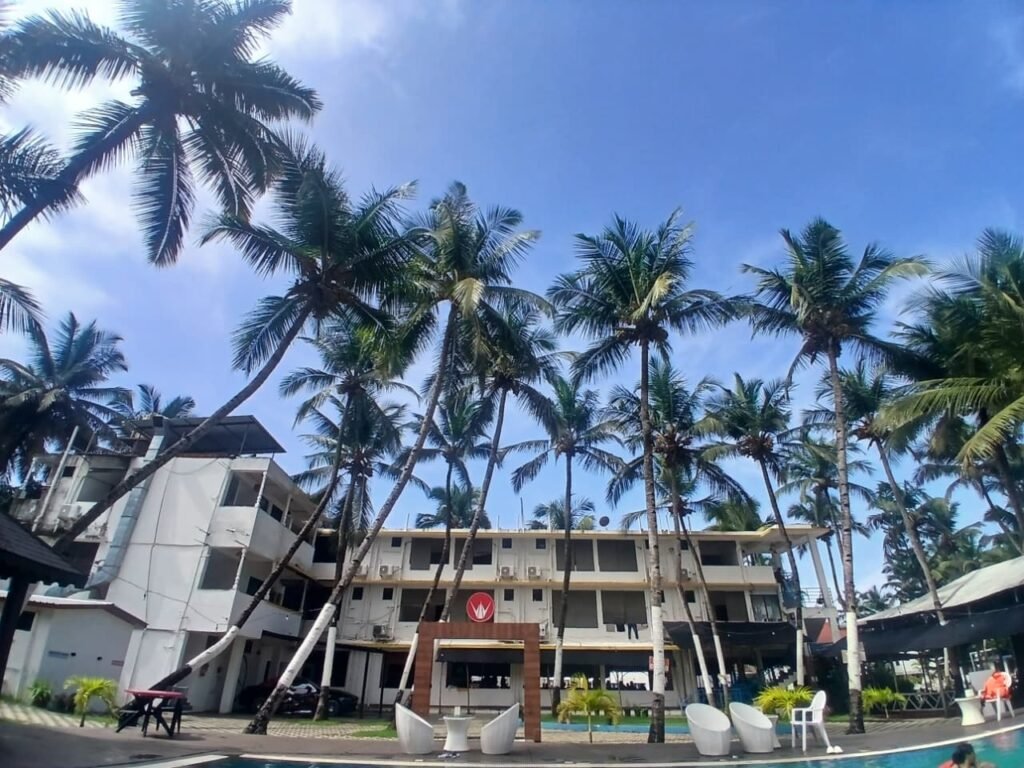
The hotel had a rooftop swimming pool.
After such a long train journey, standing beside the pool with fresh monsoon air all around us felt like the perfect way to begin our Goa adventure.
That evening, we didn’t rush to explore every tourist attraction.
Instead, we unpacked our bags, relaxed for a while, and enjoyed the feeling of finally being in Goa.
Sometimes, slowing down is the best way to begin a trip.
Sea Sapphire exterior and rooftop swimming pool during the evening.
A Lesson From Day One
If there’s one thing I learned on our very first day, it’s this:
Travel doesn’t have to begin with a checklist.
You don’t need to visit five beaches on the first afternoon.
You don’t need to rush from one attraction to another just because your itinerary says so.
Sometimes the best way to experience a new place is simply to arrive, take a deep breath, and let the destination introduce itself.
That’s exactly what Goa did for us.
And honestly, I couldn’t have asked for a better beginning.
Our First Real Day in Goa
The first evening in Goa was all about relaxing after a long train journey.
The next morning was different.
There was no train to catch.
No hotel to book.
No luggage to carry.
For the first time in days, the only thing waiting for us outside was Goa itself.
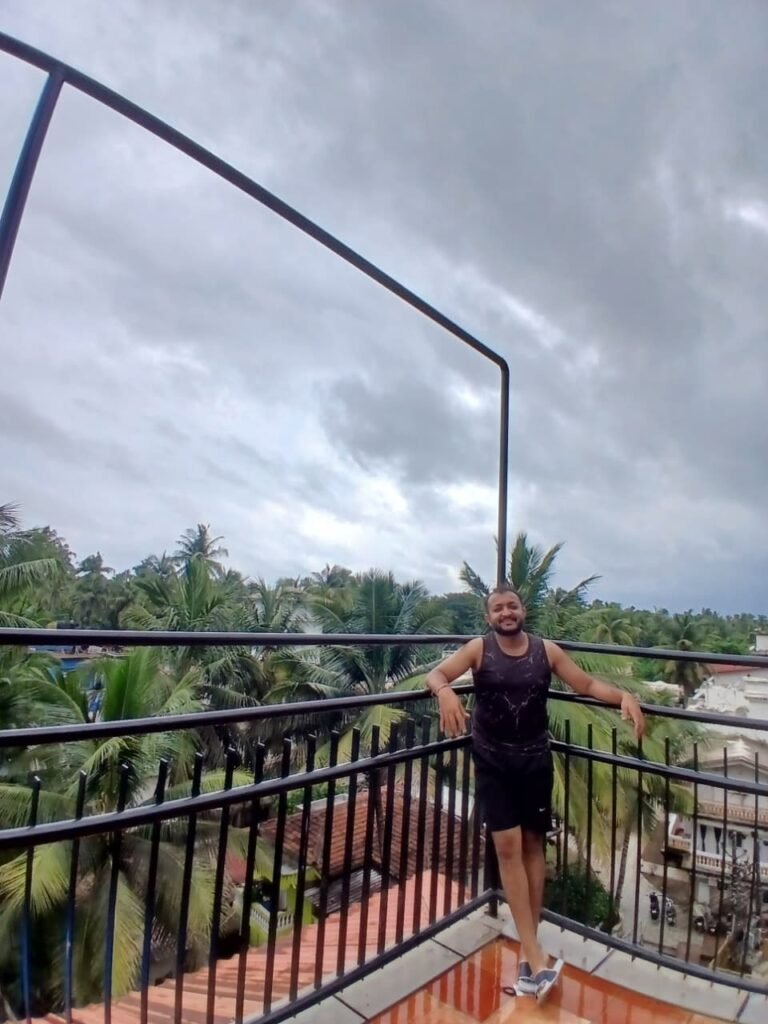
I woke up earlier than usual and walked towards the balcony.
The sound that greeted me wasn’t traffic.
It was birds.
Somewhere nearby, rainwater was dripping from coconut leaves, and a cool breeze carried the familiar smell of wet earth. After spending years in Delhi’s fast-paced environment, the silence almost felt unusual.
That morning was the moment I truly realised we had left our everyday life behind.
Our vacation had officially begun.
Breakfast with a View
One thing I appreciated about Sea Sapphire was that mornings never felt rushed.
Instead of grabbing breakfast and immediately heading out, we took our time.
The rooftop area overlooked the surrounding neighbourhood, where rows of coconut trees stretched into the distance. Dark monsoon clouds floated slowly across the sky, occasionally allowing patches of sunlight to brighten the landscape before another light shower arrived.
Goa has a reputation for being loud and energetic.
That morning showed me another side entirely.
Peaceful.
Calm.
Almost therapeutic.
Looking back, those quiet breakfasts remain some of my favourite memories from the entire trip.
Sometimes travel isn’t about ticking famous attractions off a list.
Sometimes it’s about sitting still long enough to notice where you are.
The Freedom of Having Our Own Scooter
After breakfast, we picked up our helmets and headed downstairs.
Our scooter was waiting exactly where we had parked it the previous evening.
I smiled for a moment because I realised something simple.
For the next seven days, this little scooter would decide how we experienced Goa.
Unlike organised tours, we weren’t tied to anyone else’s schedule.
If we saw an interesting road, we could take it.
If we found a café we liked, we could stop.
If a beach looked beautiful, we could spend hours there.
There was no pressure to keep moving.
That freedom became one of the biggest reasons I fell in love with travelling on two wheels.
Riding Towards Calangute Beach
Our first destination was Calangute Beach, one of the most famous beaches in Goa.
The ride itself was enjoyable.
Roads passed through colourful neighbourhoods where almost every house looked different.
Some buildings reflected Goa’s Portuguese heritage with bright yellow, blue, and red walls, while others were simple homes surrounded by gardens filled with tropical plants.
Every few kilometres, we passed small cafés, bakeries, fruit stalls, and roadside restaurants preparing breakfast for early visitors.
Even though Calangute is one of Goa’s busiest beaches, reaching it during the monsoon felt surprisingly peaceful.
The roads weren’t overcrowded.
Parking was easy.
The relaxed atmosphere made it feel as though we had arrived during Goa’s quiet season—which, of course, we had.
Road leading to Calangute Beach with palm trees and colourful Portuguese-style houses.
Calangute Beach During the Monsoon
I’ll be honest.
If you’re expecting crystal-clear blue water during the monsoon, you’ll probably be disappointed.
The sea looked completely different from the postcards.
The water was dark.
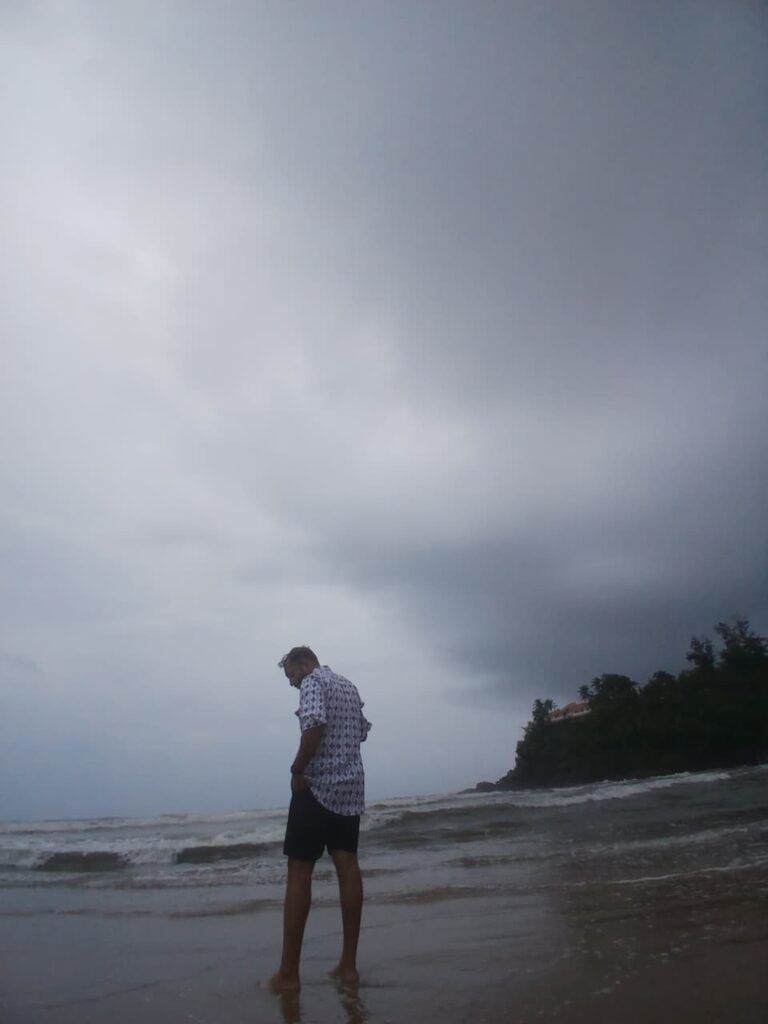
The waves were enormous.
Red warning flags fluttered along the beach, reminding visitors not to enter the sea.
But strangely, I thought it looked beautiful.
Instead of calm tropical water, nature was putting on an entirely different performance.
Huge waves crashed against the shore one after another.
Strong winds carried cool sea spray through the air.
The beach felt alive.
There weren’t many tourists swimming because it simply wasn’t safe.
Most people were doing exactly what we were doing.
Walking.
Taking photographs.
Sitting quietly and watching the ocean.
That was more than enough.
The Reality of Visiting Goa During the Rainy Season
Before travelling, I had watched dozens of YouTube videos warning people against visiting Goa during the monsoon.
Now that I was actually there, I realised the answer wasn’t so simple.
Yes, there were limitations.
Many water sports were closed.
Swimming wasn’t possible on most beaches.
Rain could interrupt your plans at any moment.
But there were advantages too.
Hotels were significantly cheaper.
The beaches weren’t overcrowded.
The weather remained pleasant throughout the day.
Most importantly, Goa looked incredibly green.
If your idea of a vacation revolves around parasailing and jet skiing, perhaps visit during winter.
But if you enjoy slow travel, photography, road trips, and peaceful beaches, don’t dismiss the monsoon so quickly.
It gave us a side of Goa that many travellers never experience.
Finding Goa Courtyard
After spending some time at Calangute, we continued exploring nearby roads before reaching Goa Courtyard, another hotel on our itinerary.
One decision we made before the trip was to avoid staying in a single hotel for the entire week.
At first, it sounded inconvenient.
Changing hotels every couple of days meant packing our bags repeatedly.
Looking back, I wouldn’t change that decision.
Every hotel introduced us to a different neighbourhood.
Instead of seeing Goa from one location, we slowly experienced different versions of it.
Goa Courtyard immediately gave us a different atmosphere from Sea Sapphire.
It was quieter, smaller, and had its own charm.
Although every hotel had strengths and weaknesses, staying in different places prevented the trip from becoming repetitive.
A Small Mistake That Became a Funny Memory
One thing you’ll quickly learn while riding around Goa is that Google Maps doesn’t always understand what you mean.
Several times during the trip, we confidently followed the navigation, only to end up on narrow village roads that clearly weren’t designed for tourists.
That happened again near Calangute.
We missed a turn, followed another road, and within minutes realised we had absolutely no idea where we were.
Instead of panicking, we laughed.
The road itself was beautiful.
Green fields stretched on both sides.
Small houses stood beneath coconut trees.
An elderly man sitting outside his home smiled as we stopped to ask for directions.
Without any hesitation, he explained the correct route in a mix of Hindi and English, even pointing towards the next junction to make sure we wouldn’t get lost again.
Those unexpected conversations often became the best parts of our journey.
Sometimes getting lost helps you discover places that no itinerary would ever include.
Lunch Like a Local
By now, we had spent most of the morning riding around North Goa.
Hunger finally caught up with us.
Instead of searching for a famous restaurant online, we stopped at a local place that looked busy with Goan families.
That’s usually a good sign.
If locals are eating there, the food is probably worth trying.
We ordered a simple meal rather than anything extravagant.
The portions were generous, the food tasted fresh, and the bill was much lower than I had expected.
That became another lesson from this trip.
The restaurants located one or two streets away from the beach often served better food at much more reasonable prices.
You don’t always need the place with the biggest signboard.
Sometimes the smaller restaurant quietly serving local customers gives you the better experience.
Baga Beach – More Than Just Nightlife
Whenever someone mentions Baga Beach, nightlife is usually the first thing that comes to mind.
I expected loud music, crowded streets, and endless party scenes.
Some of that reputation is certainly true.
But during the monsoon, Baga showed us a calmer personality.
The beach was far less crowded than I had imagined.
A few cafés remained open.
Some beach shacks welcomed visitors despite the season.
People walked along the shore, enjoying the cool breeze rather than rushing towards water activities.
The rain had transformed the atmosphere completely.
Instead of loud music dominating everything, the sound of crashing waves became the loudest thing around us.
It was a version of Baga that many travellers never get to experience.
When My Phone Almost Stopped Working
As we continued exploring, one unexpected incident reminded me how unpredictable travel can be.
Because of the constant rain and moisture, my phone was exposed to more water than I had realised.
At first, the touchscreen became slightly unresponsive.
A few minutes later, it started behaving strangely.
For a moment, I genuinely thought the phone had stopped working.
Considering that it contained our maps, hotel bookings, train tickets, and photographs, losing it would have created a serious problem.
Thankfully, after drying it carefully and giving it some time, it started functioning normally again.
That incident taught me something I now recommend to everyone visiting Goa during the monsoon.
Carry waterproof protection for your electronics.
The rain doesn’t always arrive when you expect it.
As evening approached, we rode back to our hotel, tired but happy.
It had only been our first full day exploring North Goa, yet it already felt as though we had experienced far more than we had planned.
And the best part?
We still had several days left.
Getting Lost, Finding Goa
When I think back to our trip, I don’t immediately remember famous beaches or tourist attractions.
I remember the roads.
The narrow roads that disappeared into coconut groves.
The unexpected turns that led us through tiny villages.
The moments when Google Maps confidently announced, “You have arrived,” while we stood in the middle of nowhere looking at each other, wondering where exactly “arrived” was.
Those unexpected moments slowly became the best part of our journey.
Goa was teaching us something.
Sometimes the best memories aren’t planned.
Moving to Our Third Hotel
After exploring Calangute and Baga, it was time to check out and move to our third hotel.
If someone had told me before the trip that changing hotels every two days was a good idea, I probably wouldn’t have believed them.
Packing bags repeatedly sounded exhausting.
But after experiencing it ourselves, I completely changed my opinion.
Every hotel introduced us to a different neighbourhood.
Every location changed our daily routine.
Every check-in felt like starting a new chapter.
Our third hotel cost around ₹1,500 per night, including breakfast.
From the outside, it looked simple.
But the moment we entered the property, we both smiled.
It didn’t feel like a hotel.
It felt like a private villa.
The building was surrounded by greenery, the rooms were spacious, and the atmosphere was incredibly peaceful. Unlike large commercial hotels, this place felt personal.
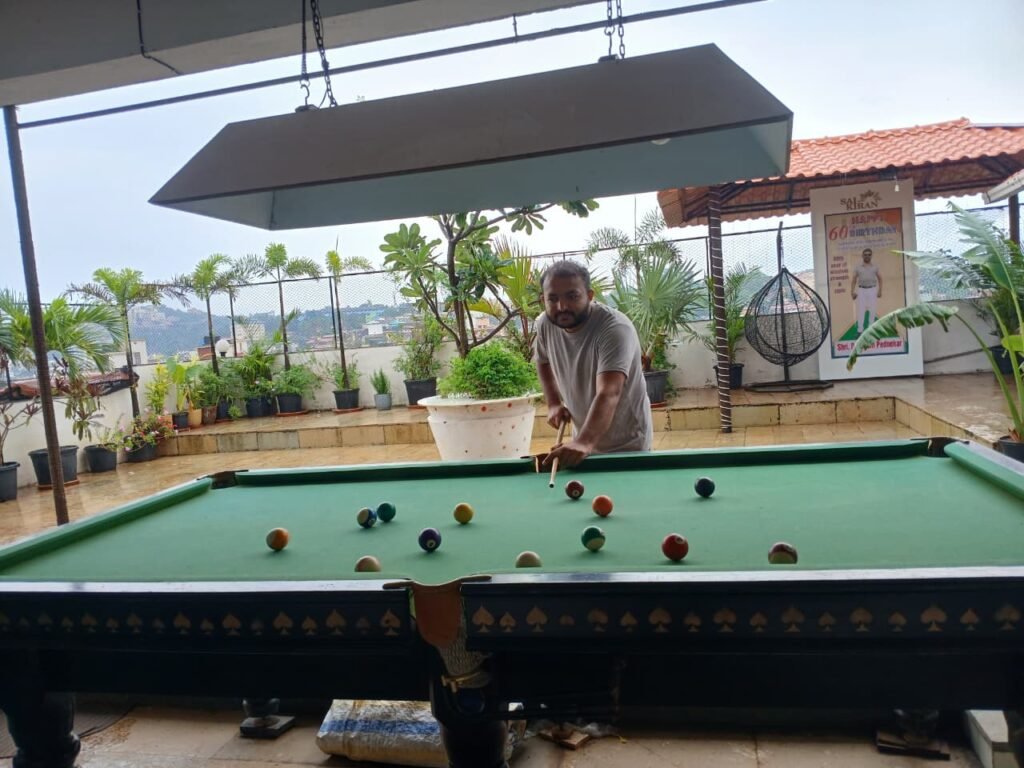
Then we discovered the rooftop swimming pool.
For the next few evenings, it became our favourite place to relax after hours of riding around Goa.
Watching the sunset from the rooftop while listening to distant thunder became part of our daily routine.
Sometimes luxury isn’t measured by how expensive a hotel is.
Sometimes it’s measured by how comfortable it makes you feel.
The villa-style hotel with its rooftop pool during the evening.
Why Staying in Different Hotels Was the Best Decision
One question I often get asked is:
“Should I stay in one hotel for the entire Goa trip?”
After our experience, my answer is simple.
No—if your budget allows it.
North Goa isn’t just one place.
Calangute feels different from Vagator.
Vagator feels different from Anjuna.
South Goa feels like an entirely different state.
By changing hotels, we weren’t just changing rooms.
We were changing our perspective.
Instead of commuting long distances every day, we experienced each area like temporary locals.
It required a little more planning, but it completely changed the quality of our trip.
Riding Towards Anjuna Beach
The next morning, we left early for Anjuna Beach.
The road itself felt like a destination.
Rain from the previous night had washed every tree clean.
The air smelled fresh.
Small cafés had just opened.
Local shopkeepers were arranging colourful souvenirs outside their stores.
The closer we came to Anjuna, the more artistic everything began to look.
Walls were painted with murals.
Tiny cafés displayed handwritten menus.
Music drifted softly from restaurants hidden behind palm trees.
Anjuna wasn’t trying to impress anyone.
It simply had its own personality.
And that’s exactly why I liked it.
Anjuna Beach – More Than Just Another Beach
If Calangute felt energetic and Baga felt commercial, Anjuna felt creative.
The beach wasn’t crowded.
People weren’t rushing from one activity to another.
Some travellers sat quietly reading books.
Others sketched the landscape.
A few photographers waited patiently for changing light between the clouds.
The monsoon had transformed Anjuna into a peaceful escape.
We walked slowly along the shoreline.
The sea was rough.
Massive waves crashed against the rocks, sending white spray high into the air.
The sky remained completely grey.
Normally, people associate sunshine with beautiful beaches.
Standing there, I realised that dramatic weather could be just as beautiful.
Maybe even more.
Exploring the Local Market
Near the beach, a colourful market stretched across several small lanes.
Instead of international brands, the stalls were filled with handmade products.
Wooden handicrafts.
Dream catchers.
Jewellery.
Beachwear.
Paintings.
Handmade bags.
The shopkeepers greeted everyone with genuine smiles rather than aggressive sales pitches.
We spent almost an hour simply walking around, talking to local vendors and admiring their work.
Even if you don’t plan to shop, don’t skip the market.
It gives Anjuna another layer of character.
Waiting for a Sunset That Never Came
One of the reasons we had reached Anjuna early was to watch the famous sunset.
Nature had different plans.
Dark clouds slowly covered the horizon.
The sky became darker every minute.
Eventually, rain arrived.
Some tourists quickly packed their belongings and left.
We stayed.
Instead of an orange sunset, we watched giant waves crashing beneath almost black clouds.
Strangely, I wasn’t disappointed.
That dramatic coastline became one of my favourite memories from the entire trip.
Travel teaches you something important.
Sometimes reality is better than expectations.
Just not in the way you imagined.
When the Rain Tested Us
As we left Anjuna, the rain became much heavier.
Within minutes, the roads were covered with water.
Visibility dropped.
We slowed the scooter and continued carefully.
Then something unexpected happened.
My backpack slipped from the scooter.
Before I could react, it landed directly on the flooded road.
Inside that bag was my laptop.
For a few seconds, my heart almost stopped.
We quickly picked it up and moved under a nearby shelter.
I checked the bag immediately.
Fortunately, most of the water had remained outside, although the laptop did get slightly wet.
For the rest of the day, I kept wondering whether it would survive.
Thankfully, it did.
Looking back now, that incident became another reminder that travel rarely goes exactly as planned.
You can prepare for almost everything.
But sometimes life simply throws unexpected moments at you.
A Small Café That Became One of My Favourite Memories
After the rain slowed, we found a small vintage-style café tucked away from the main road.
It wasn’t crowded.
It wasn’t famous.
In fact, if we hadn’t stopped because of the rain, we probably would never have noticed it.
The café immediately caught my attention.
Wooden furniture.
Old photographs hanging on the walls.
Soft music playing quietly in the background.
Warm yellow lighting.
It felt less like a restaurant and more like someone’s carefully designed living room.
This is exactly the kind of place I love discovering while travelling.
Not because it’s popular.
Because it feels authentic.
Conversations That Made the Trip Special
While waiting for our food, we started talking with two travellers from Mexico sitting at the next table.
The conversation began with a simple question.
“Where are you guys from?”
Within minutes, we were exchanging travel stories.
They told us about their experiences in India.
We shared our plans for the rest of Goa.
We laughed about getting lost.
Compared favourite destinations.
Discussed local food.
Travel has a strange way of removing barriers.
People who would probably never meet under normal circumstances can spend an hour talking like old friends.
When we finally left the café, I realised something.
I probably wouldn’t remember exactly what I ate there years later.
But I would definitely remember that conversation.
Good Food Doesn’t Have to Be Expensive
For lunch, we ordered pasta and momos.
The total bill came to around ₹300.
Considering the quality of the food, the atmosphere, and the hospitality, it felt like excellent value.
One misconception I had before visiting Goa was that every café would be expensive.
That simply wasn’t true.
If you avoid the most tourist-heavy locations and explore side streets, you’ll find fantastic cafés serving delicious food at surprisingly reasonable prices.
The Road to South Goa
As evening approached, we returned to the hotel.
The next morning would take us somewhere completely different.
Until now, almost everything we had experienced belonged to North Goa.
The beaches.
The cafés.
The markets.
The lively atmosphere.
But everyone we had spoken to—including locals—kept telling us the same thing.
“If you really want to understand Goa, don’t leave without visiting South Goa.”
The next chapter of our journey was about to begin.
And looking back today…
It turned out to be my favourite part of the entire trip.
South Goa Changed Everything
Until this point, our trip had been filled with famous beaches, lively markets, colourful cafés, and constantly changing scenery.
North Goa had been exciting.
Every road led to another attraction.
Every beach had its own personality.
Every evening ended with another story.
But the moment we started riding towards South Goa, everything began to slow down.
And honestly…
That was exactly what we needed.
The Ride I’ll Never Forget
If someone asked me to choose just one scooter ride from the entire trip, I wouldn’t choose Calangute.
I wouldn’t choose Baga.
I wouldn’t even choose Anjuna.
I’d choose the ride from North Goa to South Goa.
The distance wasn’t the reason.
The atmosphere was.
As we left the crowded roads behind, traffic gradually disappeared.
The roads became wider.
The air felt fresher.
Instead of shops lining every street, endless coconut trees stretched toward the horizon.
Small Portuguese-style houses appeared every few kilometres, each painted in bright colours with gardens full of flowers.
Occasionally, we’d pass tiny churches standing quietly beside the road.
Some roads were so empty that for several minutes we wouldn’t see another vehicle.
Those moments became my favourite part of riding through Goa.
There was no hurry.
No pressure.
No destination that had to be reached immediately.
Just two people, one scooter, and an incredibly beautiful road.
Sometimes I slowed down intentionally.
Not because I had to.
Because I wanted the journey to last a little longer.
A scenic road in South Goa lined with coconut trees after monsoon rain.
Welcome to Woodside Resort
By afternoon, we finally reached Woodside Resort.
Even before checking in, I had a feeling this place would be special.
The entrance itself looked peaceful.
Instead of large commercial buildings, the property blended naturally with the surrounding greenery.
Palm trees surrounded the walkways.
Colourful flowers filled the gardens.
Birds could be heard almost everywhere.
After spending several days changing hotels, arriving here immediately felt different.
The receptionist welcomed us warmly and completed the check-in quickly.
Then came another pleasant surprise.
Instead of the standard room we had booked, we were upgraded to a larger room with a private balcony.
Unexpected upgrades are always nice.
But this one made our stay even more memorable.
As soon as we entered the room, I walked straight to the balcony.
Looking outside, all I could see was greenery.
No traffic.
No noise.
Just nature.
For a few moments, I simply stood there without saying anything.
Sometimes silence says everything.
My Favourite Hotel in Goa
Throughout this trip, we stayed in several hotels.
Some were more luxurious.
Some had better interiors.
Some were located closer to popular attractions.
Yet none of them made me feel the way Woodside did.
Luxury isn’t always about marble floors or expensive furniture.
Sometimes it’s about how a place makes you feel.
Woodside made us slow down.
Every morning began with birds singing.
Every evening ended beside the swimming pool.
Walking from our room to breakfast meant passing through beautiful gardens rather than crowded hallways.
Everything felt calm.
Everything felt intentional.
If I return to Goa someday, this is the hotel I want to book again.
Without hesitation.
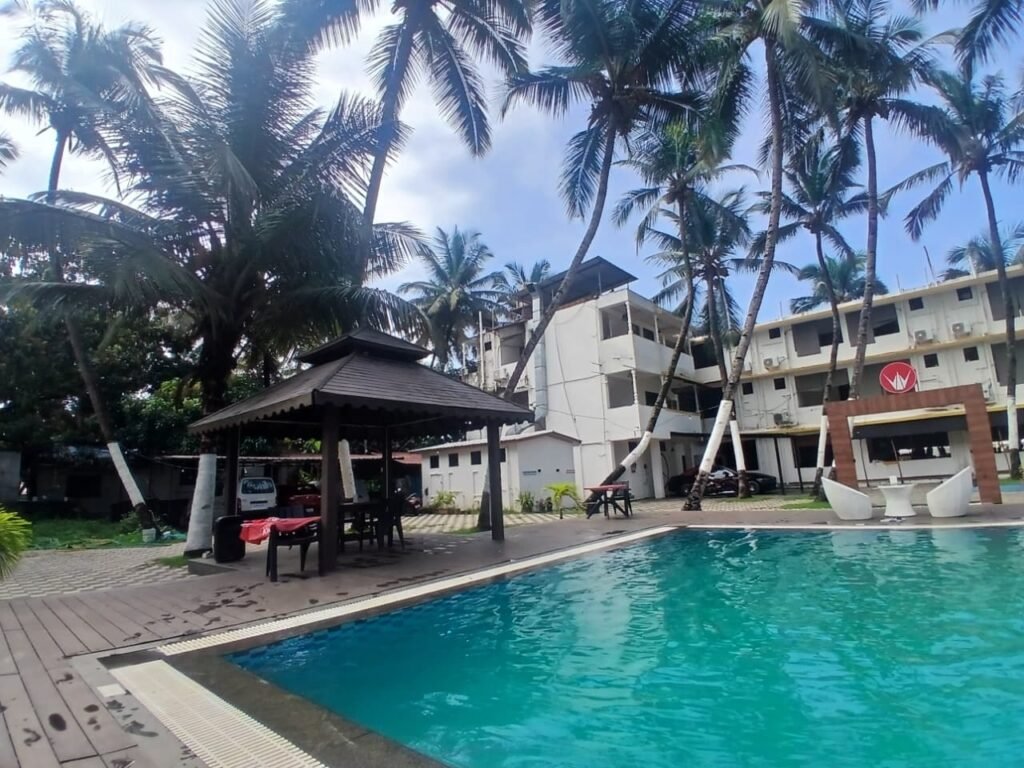
Woodside Resort swimming pool surrounded by tropical plants.
Why I Think South Goa Is Underrated
Before visiting Goa, almost every YouTube video I watched focused on North Goa.
Beach clubs.
Nightlife.
Water sports.
Party cafés.
That’s what people usually associate with Goa.
Very few creators spent much time talking about South Goa.
Now I understand why that’s unfortunate.
South Goa isn’t trying to entertain you every minute.
It simply allows you to breathe.
The beaches are quieter.
The roads are calmer.
The crowds are smaller.
Instead of loud music, you hear waves and birds.
Instead of rushing between attractions, you actually have time to enjoy them.
If you’re someone who travels to relax rather than party, don’t make the mistake of skipping South Goa.
For me, it became the highlight of the entire journey.
Benaulim Beach – Where Time Slowed Down
Later that afternoon, we rode to Benaulim Beach.
Unlike Calangute or Baga, there were no large crowds waiting to take selfies.
No loud music echoed across the shoreline.
Instead, the beach welcomed us with something much simpler.
Peace.
The Arabian Sea looked powerful.
Because of the monsoon, enormous waves rolled toward the shore one after another.
Dark clouds stretched across the sky.
Strong winds carried tiny droplets of seawater through the air.
We found a quiet place to sit.
And we stayed there for almost an hour.
Without speaking much.
Sometimes people think silence is awkward.
Travel taught me something different.
Silence can also be comforting.
As I watched the waves, I realised how rarely we allow ourselves to do absolutely nothing.
Back home, every minute feels scheduled.
There’s always another notification.
Another deadline.
Another responsibility.
Sitting beside the sea, none of those things mattered.
For that one hour, life became wonderfully simple.
Meeting Someone I’ll Always Remember
Near the beach stood a large Buddha statue where a local fisherman was talking with a few visitors.
Out of curiosity, we walked over.
That simple decision gave us one of the most meaningful conversations of the entire trip.
He introduced himself with a warm smile and immediately started talking about life in Goa.
Fishing wasn’t just his profession.
It was part of his family’s history.
As we continued talking, he mentioned something that surprised us.
Over the years, he had received several tourism awards for promoting Goa and helping visitors understand local life.
He also shared that thousands of people followed him on social media because he regularly posted about fishing, the sea, and Goan culture.
Despite all of that, he remained incredibly humble.
He wasn’t trying to impress anyone.
He simply enjoyed sharing stories.
We spoke about tourism, the changing seasons, monsoon fishing, and how Goa had changed over the years.
That conversation reminded me that every destination has two stories.
One belongs to tourists.
The other belongs to the people who actually call it home.
The second story is almost always more interesting.
Dinner After the Perfect Day
As evening approached, we returned to a nearby restaurant for dinner.
After several days of trying different cuisines, we ordered something familiar.
Chicken Biryani.
Egg Biryani.
Simple food.
Comforting flavours.
Sometimes, after a long day of travelling, that’s exactly what you need.
Back at the resort, we took one last walk around the property before going to bed.
The swimming pool reflected the lights from the surrounding trees.
The sound of insects replaced the noise of traffic.
For the first time since arriving in Goa, I wasn’t thinking about the next destination.
I was simply enjoying where I already was.
That night, before sleeping, I wrote something in my notes.
“If Goa has a soul… I think I found it in South Goa.”
Goa’s Final Chapters: History, Friendship & One Last Sunset
By this point, our trip had settled into a comfortable rhythm.
We no longer checked Google Maps every few minutes.
We had become used to riding through Goa’s roads, parking the scooter near beaches, and discovering places that weren’t part of our original plan.
But our journey wasn’t over yet.
Some of the most memorable experiences were still waiting for us.
Leaving Woodside Resort
Checking out of Woodside Resort was surprisingly difficult.
Usually, checking out of a hotel is just another step in a journey.
This time, it felt different.
Over the past few days, the resort had become more than just a place to sleep.
It had become home.
As we loaded our luggage onto the scooter one final time, I looked back at the property.
The gardens were still glistening from the morning rain.
The swimming pool was perfectly still.
The staff waved goodbye with genuine smiles.
Some hotels give you a room.
Others give you memories.
Woodside belonged to the second category.
If anyone ever asks me for a hotel recommendation in South Goa, this will always be my first suggestion.
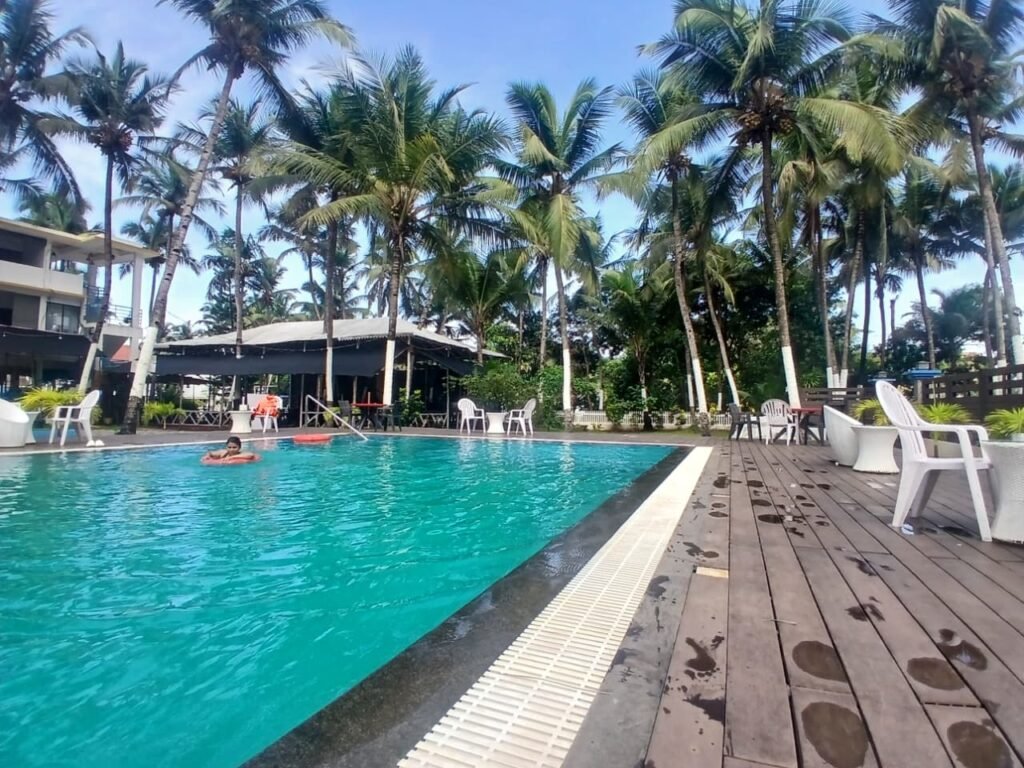
A morning view of Woodside Resort with rain-soaked gardens and tropical greenery.
Heading Towards Vasco da Gama
Our next destination was Vasco da Gama, one of Goa’s oldest and most important cities.
The ride itself was enjoyable.
Unlike the tourist-heavy coastal roads, Vasco felt like a city where everyday life continued regardless of tourism.
People hurried to work.
Students waited outside schools.
Small bakeries were already busy serving breakfast.
For the first time during our trip, we weren’t looking at Goa through the eyes of tourists.
We were watching daily life unfold.
That made the city feel authentic.
Checking Into Regenta
For our next stay, we checked into Regenta.
Compared to Woodside Resort, the atmosphere here was completely different.
Regenta felt modern and business-like.
The rooms were spacious, the interiors looked elegant, and every facility was professionally maintained.
The check-in process was smooth, and within a few minutes we were relaxing in our room.
Although I personally preferred the peaceful atmosphere of Woodside, Regenta offered a completely different experience.
If you’re travelling for comfort and convenience—especially around Vasco—it is a solid choice.
Every hotel we stayed in represented a different side of Goa.
That variety became one of the highlights of our trip.
Meeting Sachin from the Indian Navy
Sometimes, the best travel memories don’t come from places.
They come from people.
One evening, while exploring Vasco, we met Sachin, who served in the Indian Navy.
Our conversation started casually.
He asked where we had travelled from.
We told him we were visiting from Delhi.
From there, the discussion naturally shifted toward Goa.
Instead of talking only about tourist attractions, Sachin shared what it was like living and working in a coastal city.
He spoke about discipline, life in the Navy, and how Goa changes dramatically between the tourist season and the monsoon.
Listening to someone who actually lived there gave us a completely different perspective.
Tourists usually see Goa through beaches and hotels.
Residents experience an entirely different Goa.
Before leaving, we thanked him for sharing his experiences.
It was another reminder that travel becomes richer when you take the time to talk to people.
Exploring Panjim
The following day, we headed towards Panjim, Goa’s capital city.
Unlike the beach towns we had already visited, Panjim felt more urban.
Wide roads.
Colourful Portuguese buildings.
Government offices.
Local markets.
Riverside cafés.
The city had a relaxed charm that was completely different from North Goa’s party atmosphere.
Walking through Panjim felt like walking through history.
Many buildings still reflected Portuguese architecture, with bright colours, wooden balconies, and decorative windows.
Instead of rushing from one attraction to another, we simply walked through the streets, stopping whenever something caught our attention.
Sometimes that’s the best way to explore a city.
Without a strict itinerary.
Dona Paula – Where the Sea Meets the Sky
Our next stop was Dona Paula.
Even with grey monsoon clouds covering the sky, the viewpoint looked spectacular.
Standing there, watching the Arabian Sea stretch endlessly toward the horizon, I understood why this place remains one of Goa’s most visited attractions.
The waves crashed against the rocks below.
Strong winds made it difficult to stand still.
Tourists gathered near the viewpoint, taking photographs despite the occasional drizzle.
The weather wasn’t perfect.
Yet somehow, it made everything feel even more dramatic.
Goa had taught me by now that beauty doesn’t always require sunshine.
Miramar Beach
From Dona Paula, we continued to Miramar Beach.
Compared to the beaches we’d already visited, Miramar had a very different atmosphere.
Families walked together along the shore.
Children chased waves despite repeated warnings from parents.
Couples sat quietly beneath umbrellas, enjoying the cool breeze.
There wasn’t much noise.
No loud parties.
No beach clubs demanding attention.
Just a peaceful coastline where people came to spend time together.
We walked slowly across the wet sand, leaving footprints that disappeared almost immediately beneath the incoming waves.
Travel often reminds us how temporary everything is.
Those footprints disappeared within seconds.
The memory never did.
The White Church
One place we especially wanted to visit was the beautiful white church that we’d heard so much about.
As we approached, its bright white exterior stood out against the dark monsoon sky.
The contrast was breathtaking.
Inside, everything felt calm.
Visitors spoke softly.
Some prayed quietly.
Others simply admired the architecture.
Regardless of your religion, places like this invite you to slow down and appreciate the history surrounding you.
After spending time there, we stepped back outside into the cool afternoon air and continued our journey.
An Evening to Remember – Nirvana Dinner Cruise
Our final major experience in Goa was the Nirvana Dinner Cruise.
After spending days exploring beaches, villages, and cities, ending the trip on a cruise felt like the perfect finale.
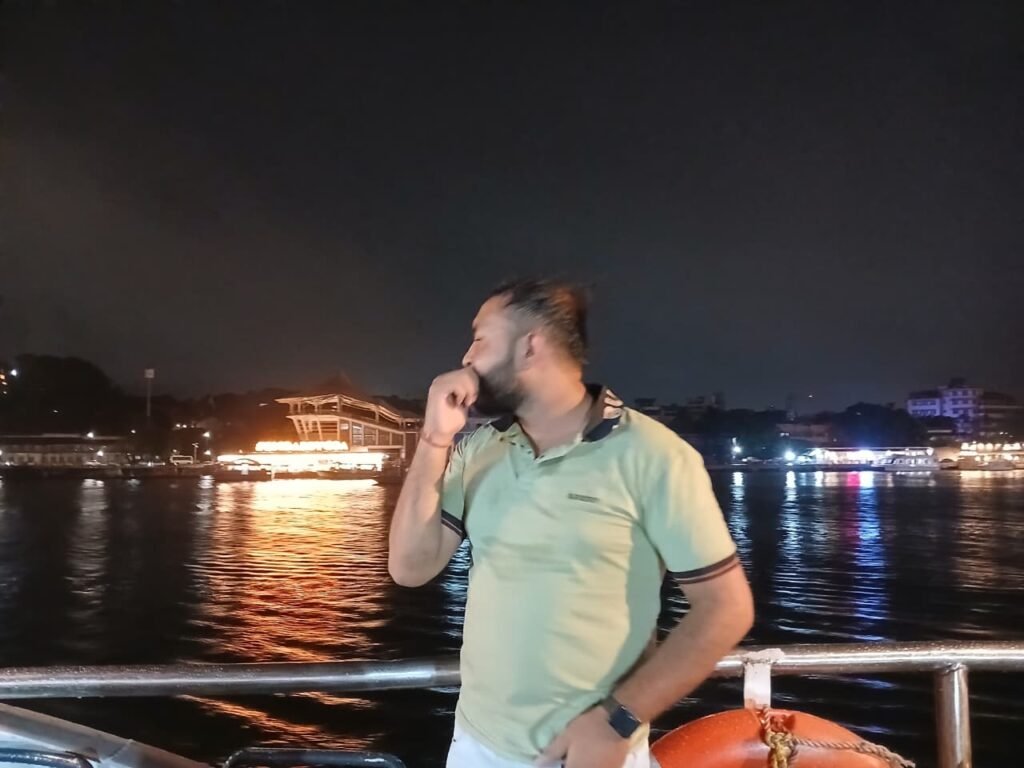
As the boat slowly moved across the river, the city lights reflected beautifully on the water.
The atmosphere was lively without feeling overcrowded.
Music played throughout the evening.
There were cultural performances, dancing, and a buffet dinner that gave everyone time to relax and enjoy the experience.
Watching Goa from the water offered a completely different perspective from everything we’d seen on land.
The breeze was cool.
The rain had finally paused.
For a while, we simply stood on the deck looking at the lights shimmering across the river.
It was one of those quiet moments where you realise a journey is coming to an end.
And you’re already starting to miss it.
One Last Ride
Later that night, we rode our scooter back through Goa’s peaceful roads one final time.
By then, those roads no longer felt unfamiliar.
The scooter that had seemed intimidating on the first day now felt completely natural.
We knew where to stop for tea.
We recognised familiar landmarks.
Even the winding roads somehow felt like home.
I realised something during that final ride.
A week earlier, Goa had been just another destination on a map.
Now it had become a collection of memories.
Not because of famous beaches.
Not because of Instagram photos.
But because of the small moments in between.
The conversations.
The rain.
The wrong turns.
The quiet evenings.
Those are the moments that stay with you long after a trip ends.
The Journey Home, Budget Breakdown & Everything I Learned
Every trip reaches a point where excitement quietly turns into reflection.
For us, that moment arrived on our final morning in Goa.
Our bags were packed once again.
The scooter that had carried us through beaches, villages, cities, and endless rain had to be returned.
The hotel room, which had felt like home for a few days, was suddenly just another room.
It was time to leave.
Returning the Scooter
If there was one decision that completely changed our Goa experience, it was renting a scooter.
For seven days, it gave us something taxis never could.
Freedom.
We weren’t dependent on drivers.
We didn’t have to negotiate fares.
We didn’t need to plan every movement.
Whenever we wanted to stop for tea, take photographs, or explore a road that looked interesting, we simply parked and enjoyed the moment.
Returning the scooter was surprisingly emotional.
The owner inspected it carefully.
Thanks to the photos and videos we had taken on the first day, the inspection finished quickly.
Our ₹2,000 security deposit was returned without any problems.
Abhinav’s advice on the train had proved valuable once again.
My advice:
Always record a complete video of the scooter before leaving the rental shop. It takes only two minutes and can save you from unnecessary disputes.
One Last Look at Goa
Before leaving for the railway station, we took one final ride through the nearby streets.
The same roads that had felt unfamiliar a week earlier now felt strangely familiar.
We recognised cafés.
We remembered where we had taken photographs.
Even the roadside coconut trees felt like old companions.
Travel has a funny way of doing that.
Places you’ve never seen before slowly begin to feel like somewhere you’ve known for years.
As we rode away, I wasn’t thinking about the places we had visited.
I was thinking about the moments between them.
Those quiet rides.
Unexpected conversations.
The sound of rain hitting the helmet visor.
The smell of the sea after a storm.
Those are the memories that stay with you.
The Return Journey
Returning home always feels different from arriving.
On the way to Goa, every station brought excitement.
On the way back, every passing kilometre reminded us the trip was ending.
The train journey home felt quieter.
We spent more time looking through photographs than looking out of the window.
Each picture instantly brought back another story.
“Remember when we got lost?”
“Remember that café in Anjuna?”
“Remember the fisherman at Benaulim?”
The journey home wasn’t boring.
It simply felt reflective.
When Things Didn’t Go as Planned
No trip is perfect.
Ours certainly wasn’t.
During the return journey, we faced an issue with the railway service that eventually led us to file a complaint.
Without going into unnecessary detail, it reminded me that even well-planned trips can have unexpected challenges.
The important thing is staying calm and using the proper channels when something goes wrong.
Travel isn’t about having a perfect itinerary.
It’s about handling imperfect situations without letting them ruin the experience.
Our Final Hotel Stays
Before completing our journey, we also stayed at Sai Kiran Tower and Riya Residency.
Since many people ask for honest hotel recommendations, here’s my genuine opinion.
Sai Kiran Tower
Sai Kiran Tower was comfortable, clean, and offered good value for money.
The rooms were spacious enough for a short stay, and the staff were helpful whenever we needed assistance.
If you’re looking for a practical place to stay without spending too much, it’s worth considering.
Riya Residency
Out of all the hotels we stayed in, Riya Residency was probably my least favourite.
That doesn’t mean it was terrible.
It simply didn’t leave the same positive impression as the others.
The overall experience felt average, and after staying at places like Woodside Resort and Sea Sapphire, the difference became quite noticeable.
Sometimes that’s how travel works.
Not every hotel becomes memorable.
My Honest Hotel Rankings
After staying in multiple properties across Goa, here’s how I’d personally rank them.
| Hotel | My Rating | Comments |
|---|---|---|
| Woodside Resort | ⭐⭐⭐⭐⭐ (5/5) | My favourite stay. Peaceful, beautiful, relaxing, and perfect for South Goa. |
| Sea Sapphire | ⭐⭐⭐⭐☆ (4.5/5) | Great value, rooftop pool, excellent start to the trip. |
| Regenta | ⭐⭐⭐⭐☆ (4.5/5) | Modern, comfortable, and professionally managed. |
| Goa Courtyard | ⭐⭐⭐⭐☆ (4/5) | Quiet location and pleasant atmosphere. |
| Villa-style Hotel | ⭐⭐⭐⭐☆ (4/5) | Spacious rooms and a relaxing rooftop pool. |
| Sai Kiran Tower | ⭐⭐⭐⭐ (4/5) | Comfortable and practical. |
| Riya Residency | ⭐⭐⭐ (3/5) | Average experience compared to the others. |
Our Goa Budget Breakdown
One of the biggest questions people ask is:
“How much does a Goa trip actually cost?”
Based on our real experience, here’s a realistic estimate.
| Expense | Approximate Cost |
|---|---|
| Train Tickets | ₹3,000–₹5,000 |
| Hotels | ₹8,000–₹10,000 |
| Scooter Rental | ₹3,500 |
| Fuel | ₹800–₹1,200 |
| Food & Cafés | ₹4,000–₹5,000 |
| Dinner Cruise | Varies depending on package |
| Miscellaneous | ₹2,000 |
Total Cost
Approximately ₹20,000–₹25,000 per person
For a week-long trip covering both North and South Goa, I felt this offered excellent value.
Things I Wish I Had Known Before Visiting Goa
Looking back, there are several things I would tell anyone planning a similar trip.
- Rent a scooter if you’re comfortable riding one.
- Record a complete video of the vehicle before leaving the rental shop.
- Carry a waterproof bag for your phone, camera, and laptop.
- Don’t try to cover all of Goa in two or three days.
- Spend time in South Goa—it deserves at least two or three days.
- Visit during the monsoon only if you’re happy to skip most water sports.
- Don’t judge restaurants only by their location. Some of the best meals are found away from the busiest beaches.
- Leave room in your itinerary for unexpected discoveries.
Common Mistakes to Avoid
During our trip, we made a few mistakes that are easy to avoid.
- Depending entirely on Google Maps without checking road signs.
- Assuming every famous beach would be the most enjoyable.
- Underestimating how quickly monsoon rain can arrive.
- Forgetting to protect electronic devices from moisture.
- Planning every hour instead of leaving time to explore freely.
Frequently Asked Questions
Is Goa worth visiting during the monsoon?
Yes—if you enjoy greenery, fewer crowds, scenic drives, and peaceful beaches. If your main goal is water sports, winter is a better season.
Is North Goa or South Goa better?
They’re very different. North Goa is lively and energetic, while South Goa is quieter and more relaxing. If possible, experience both.
Is renting a scooter in Goa worth it?
Absolutely. It gave us flexibility, saved money, and allowed us to explore places that would have been difficult to reach by taxi.
How many days are enough for Goa?
I recommend at least seven days if you want to explore both North and South Goa without rushing.
Is ₹25,000 enough for a Goa trip?
Yes. Based on our experience, ₹20,000–₹25,000 per person is enough for a comfortable week-long trip if you travel by train and plan your accommodation carefully.
Final Thoughts – The Goa I’ll Always Remember
When I first planned this trip, I thought Goa would be about beaches, nightlife, and famous tourist attractions.
That’s certainly part of the story.
But it isn’t the whole story.
The Goa I’ll always remember is the one hidden between those attractions.
It’s the family on the train who recommended our first hotel.
It’s Abhinav reminding us to inspect the scooter before riding away.
It’s the wrong turn that led us through quiet villages.
It’s the conversations with strangers who welcomed us with genuine warmth.
It’s the award-winning fisherman sharing stories about the sea.
It’s Sachin from the Indian Navy offering a local’s perspective on life in Goa.
It’s the sound of monsoon rain falling outside a hotel room.
It’s watching giant waves crash against the shore while the sky turned almost black.
It’s discovering that the best memories often come from moments you never planned.
Goa gave me much more than photographs.
It gave me stories.
And years from now, when I look back at this journey, I probably won’t remember the exact hotel prices or how many kilometres we travelled.
I’ll remember how the trip made me feel.
Calm.
Curious.
Grateful.
If you’re planning your own Goa adventure, my advice is simple.
Don’t try to copy someone else’s itinerary—including mine.
Use this guide as a starting point, but leave space for your own discoveries.
Because somewhere on a quiet road, in a small café, on a rainy beach, or during an unexpected conversation, you’ll find your own version of Goa.
And that will be the one you remember forever.
Thank you for reading.
If this guide helped you plan your trip, or if you’ve already visited Goa and had a different experience, I’d love to hear your story. Travel is at its best when we share what we’ve learned with one another.
See you in the next adventure on Wander With Money.
Also See From where You have to Start START HERE, CONTACT