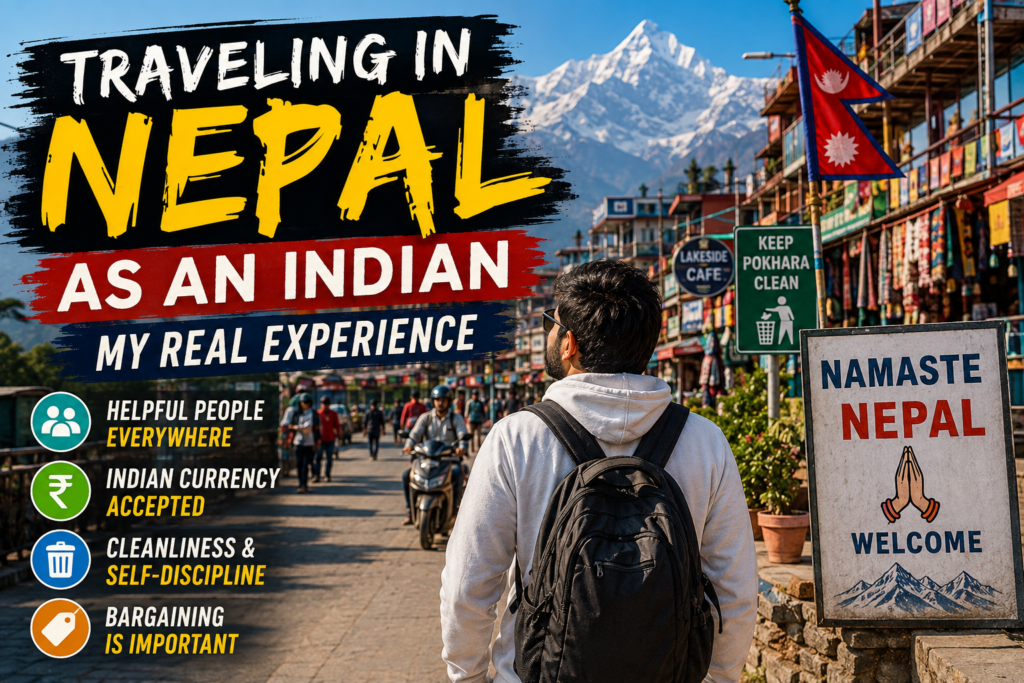
When I think about our Nepal trip, I don’t remember only the mountains, lakes, temples and tourist attractions.
One of the biggest things I remember is how people treated us and how different everyday life felt compared with what I had expected.
We went to Nepal as Indian travellers, and throughout the journey we had several situations where we needed help, directions, transport and information. Sometimes we asked people directly, sometimes we learned things through conversations, and sometimes we simply observed how people lived around us.
What surprised me most was that Nepal felt very comfortable to travel through.
The country may not be as economically developed as some places, but there were several things about the people and their way of living that genuinely impressed me.
This is not a generic Nepal travel guide.
This is simply what I personally experienced during our Nepal trip.
Our Nepal Trip Was Mostly Unplanned
One of the reasons I noticed these things so much was because our trip wasn’t perfectly planned.
We didn’t have someone with us who already knew every place.
We often had to figure things out ourselves.
If we didn’t know where to go, we asked someone.
If we needed information about transport, we asked.
If we were confused about a route, we asked people around us.
And that meant we had many opportunities to interact with people.
Instead of simply moving from one pre-booked destination to another, we were actually communicating with people along the way.
That made the experience much more personal.
The People We Met Were Very Helpful
One of the first things I noticed was how helpful people could be when we needed assistance.
There were several situations where we initially took help from other people, and then they explained the route or situation to us properly.
This happened during our travels when we were trying to understand where we needed to go and how to continue our journey.
Even during our return journey by bus, we spoke with people around us and took their help.
They explained things to us and helped us understand the journey.
For someone travelling in an unfamiliar country, this kind of help makes a huge difference.
You may have Google Maps.
You may have your phone.
But sometimes a person sitting next to you can explain something in thirty seconds that would take you twenty minutes to figure out yourself.
The Feeling of Travelling as an Indian
As an Indian traveller, one thing that made the journey convenient was the familiarity of the environment.
There were cultural similarities that made us feel comfortable.
We could communicate easily with people.
We also met other Indian travellers during the journey.
Especially around tourist areas, it wasn’t unusual to come across Indian visitors.
That made the trip feel less unfamiliar.
At the same time, Nepal still had its own identity.
The architecture, landscapes, local products, temples and overall environment were different enough to make us feel that we were genuinely experiencing another country.
That balance was interesting.
It felt familiar in some ways and completely different in others.
Indian Currency Was Convenient
Another thing we noticed during the trip was the convenience of Indian currency.
During our experience, Indian currency was usable, which made some everyday transactions easier for us.
We didn’t have to worry about converting money for every small purchase.
For an Indian traveller, that can make the practical side of a trip much simpler.
Of course, I would still recommend checking the current currency rules and exchange situation before travelling because policies and acceptance can change.
But based on our experience, using Indian currency was convenient.
Bargaining Was Part of the Experience
One thing I would definitely tell other Indian travellers is:
Be prepared to bargain.
During our trip, we noticed that prices could vary depending on the situation, distance and negotiation.
This was especially relevant when dealing with local transport and shopping.
If you simply accepted the first price you were given, you could end up paying more than necessary.
So we learned to ask the price first and then negotiate.
It wasn’t about arguing over every small amount.
It was simply about understanding that the first price wasn’t necessarily the final price.
City-to-City Travel Prices Can Vary
We also noticed that the cost of travelling from one city to another could vary.
Distance was obviously one factor.
But negotiation also played a role in some situations.
So if you’re travelling around Nepal without a fixed transport package, don’t assume that every journey will have exactly the same pricing.
Ask first.
Understand the distance.
Compare if possible.
And negotiate when appropriate.
That was part of how we travelled.
The Cleanliness Really Impressed Me
But the thing that probably impressed me most was cleanliness.
We noticed that several areas we visited were maintained quite well.
There wasn’t the kind of garbage lying around everywhere that you sometimes see in crowded places.
What impressed me wasn’t only the cleaning done by authorities or workers.
It was the behaviour of people themselves.
People seemed more conscious about where they threw things.
Using dustbins and keeping the surroundings clean felt like a part of everyday behaviour.
And that made me think about something much bigger.
Development Is Not Only About Buildings
A country can have modern buildings.
It can have big roads.
It can have expensive cars.
It can have huge shopping centres.
But if people don’t have basic civic discipline, the city can still feel poorly developed.
During our Nepal trip, I realized that self-discipline is also a form of development.
If people themselves take responsibility for keeping their surroundings clean, the entire city benefits.
You don’t necessarily need someone standing behind every person telling them:
“Please don’t throw that here.”
People should already understand it.
That attitude impressed me.
Nepal May Be Developing, But People Can Still Have a Strong Civic Sense
This was probably one of my strongest observations from the trip.
Nepal is still developing economically.
You can see that in infrastructure and in some of the roads and facilities.
But development doesn’t happen in only one direction.
A place can have limitations in infrastructure while still having people with good habits.
That’s what I felt during our journey.
The way people maintained their surroundings made a positive impression on me.
It made me think that if economic development and this kind of civic discipline continue together, the cities can become even better in the future.
Women Running Businesses Also Stood Out to Me
Another thing I noticed during our travels was seeing women involved in businesses and running their own work.
We came across women handling businesses and participating actively in the local economy.
For me, that was another positive observation.
It showed a sense of independence and participation in everyday business life.
Again, I’m only talking about what I personally noticed during our trip—not making a broad claim about every part of Nepal.
But those individual observations stayed with me.
The Markets Had Their Own Character
We also spent time in local markets during the trip.
One example was around Paatal Lok.
After coming out from the caves, we found a market area where there were plenty of Nepali products and things that could be bought as memories.
We walked around and looked at different items.
These markets were useful if you wanted to take something small back home as a reminder of the trip.
And again, bargaining could be part of the shopping experience.
Talking to Locals Helped Us Discover Places
Because our trip wasn’t completely planned, conversations with people became an important part of our travel planning.
We would ask people where we should go.
Sometimes they would tell us about another place.
Sometimes they would explain how to reach somewhere.
And sometimes we’d hear about a location that wasn’t even on our original list.
That’s how travelling can become more interesting when you leave some space in your itinerary.
You don’t just follow your original plan.
You allow the destination to give you new ideas.
Our Pokhara Experience Was Built Around These Conversations
Pokhara was a perfect example.
We were exploring around the city and asking people about places to visit.
That led us to different experiences.
We explored Lakeside.
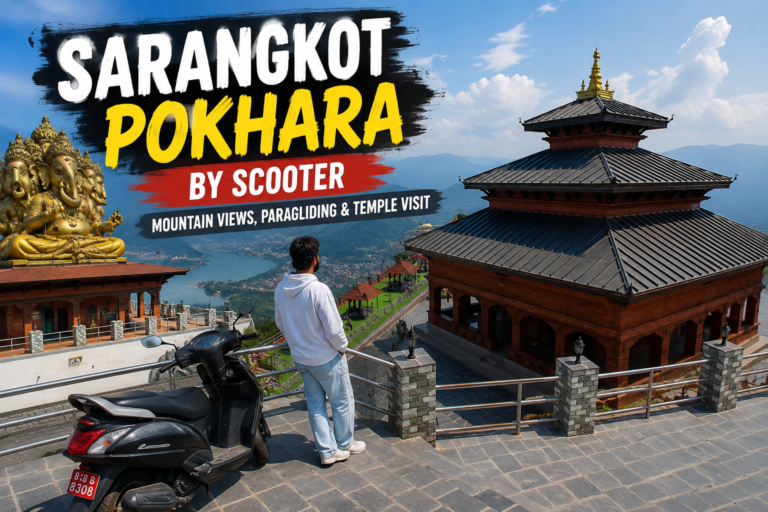
We travelled towards Sarangkot.
We went to Pumdikot.
And we eventually discovered Paatal Lok.
Each place gave us a different experience.
And many of these decisions happened naturally rather than being part of a rigid itinerary.
Travelling Without a Fixed Plan Has Its Advantages
There are definitely disadvantages to travelling without a plan.
You can waste time.
You can get confused.
You can pay more than expected.
You can struggle to find transport.
But there is another side.
You have freedom.
If someone tells you about an interesting place, you can go.
If the weather changes, you can change your plan.
If you like a city, you can stay longer.
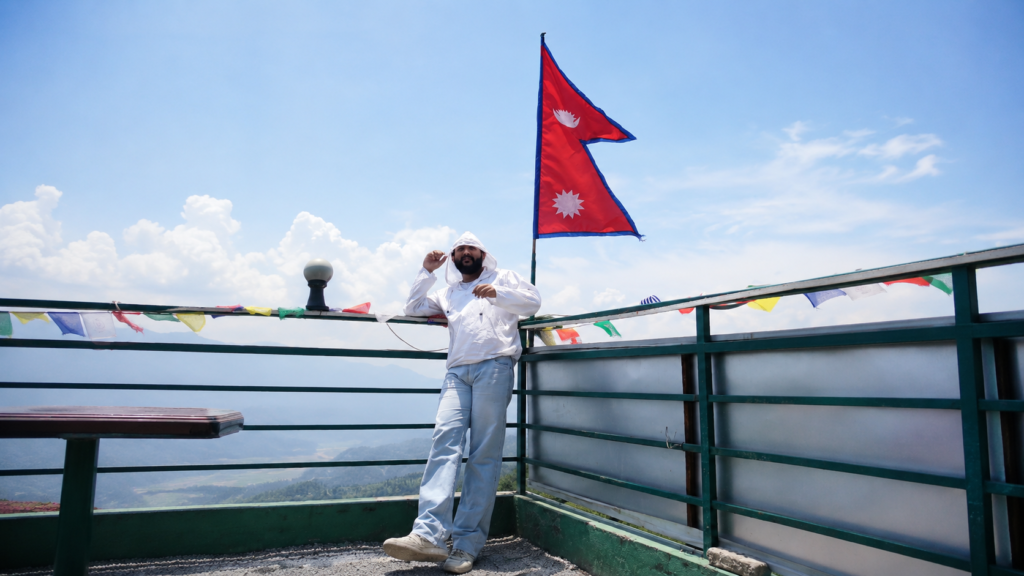
That’s exactly what happened with us in Pokhara.
We originally expected to spend less time there, but we enjoyed the place enough to stay around three days.
The People Became Part of Our Travel Memories
When I look back at the photographs from Nepal, most of them are of places.
Mountains.
Temples.
Caves.
Lakes.
Roads.
But some of my strongest memories aren’t photographs at all.
They’re conversations.
Someone explaining a route.
Someone helping us understand transport.
Someone telling us where to go.
Someone negotiating a price.
Another traveller sharing their experience.
Those moments don’t necessarily make it into a travel album.
But they stay in your memory.
Nepal Felt Welcoming to Us
Overall, our experience with people in Nepal was very positive.
We felt comfortable asking for help.
We were able to communicate.
We met people who were willing to explain things.
And we never felt like we had to completely figure everything out alone.
That doesn’t mean every interaction was perfect.
No country or trip works that way.
But overall, the people we interacted with contributed positively to our experience.
What I Would Tell Other Indian Travellers
If you’re an Indian planning to travel to Nepal, my advice based purely on our experience would be simple.
Don’t be afraid to ask people for help.
If you don’t know the route, ask.
If you don’t understand the price, ask.
If you’re unsure about transport, ask.
And if someone gives you a price that feels high, negotiate politely.
At the same time, don’t assume that every person is trying to overcharge you.
Just understand the price and make your decision.
Keep Some Flexibility in Your Trip
I would also recommend leaving some flexibility in your itinerary.
Our best experiences weren’t always the ones we had planned beforehand.
Paatal Lok wasn’t originally the main focus of our day.
Sarangkot became an adventure because we were exploring by scooter.
Pumdikot became memorable because of the journey and the mountain surroundings.
Even our evenings around Lakeside became special because we weren’t rushing to the next scheduled activity.
Sometimes you need empty space in your travel plan.
My Biggest Takeaway From Nepal

If I had to summarize what I learned from travelling around Nepal, it would be this:
A country’s development isn’t measured only by how modern its buildings look.
The way people behave matters too.
Clean surroundings.
Self-discipline.
Helping others.
Respecting public spaces.
Women participating in businesses.
People being willing to guide travellers.
All of these small things contribute to the overall character of a place.
And those are the things I noticed during our trip.
Would I Recommend Nepal to Other Indians?
Yes.
Based on our experience, Nepal is a destination where Indian travellers can have a very enjoyable trip.
You can experience mountains.
You can explore lakes.
You can visit temples.
You can explore caves.
You can ride scooters through mountain roads.
You can sit in cafés.
You can experience nightlife.
And you can interact with people along the way.
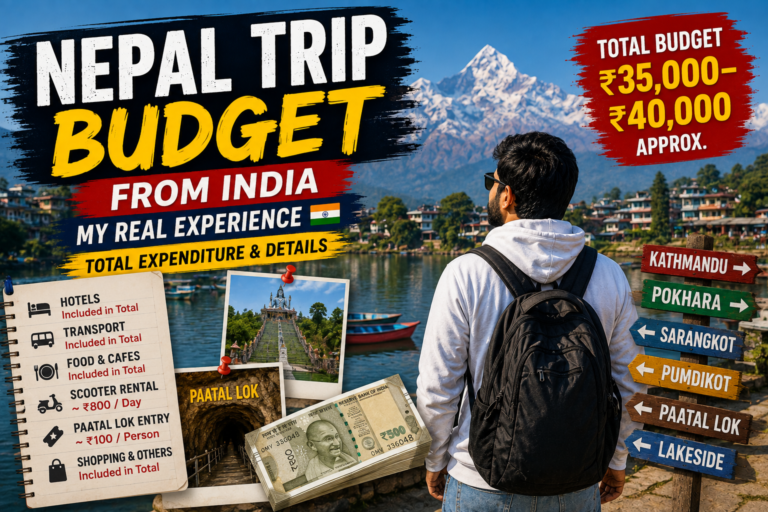
Our total trip budget was approximately ₹35,000–₹40,000, including our overall travel expenses.
The exact budget will obviously depend on your route, number of days, hotels, food, transport and activities.
But our experience showed us that you don’t necessarily need an extremely expensive trip to enjoy Nepal.
Final Thoughts
Our Nepal trip gave us many beautiful photographs.
But the photographs aren’t the whole story.
The real story was everything that happened between them.
It was asking strangers for help.
It was negotiating transport.
It was travelling through unfamiliar roads.
It was discovering markets.
It was watching people maintain their surroundings.
It was sitting in a café.
It was riding a scooter through the mountains.
It was getting nervous inside a narrow cave.
It was talking to other travellers.
And eventually, it was sitting on a bus and travelling back towards Delhi.
For me, that’s what made Nepal special.
The destination was beautiful, but the people and everyday experiences made the journey memorable.
And if you ever go to Nepal, don’t just look at the mountains.
Look at how people live.
Talk to them.
Ask questions.
Observe the small things.
Because sometimes the most interesting part of travelling isn’t the place you’re visiting.
It’s the people who help you understand it.
Also See related Article India to Nepal by Bus (2026): My Completely Unplanned 7-Day Trip from Delhi to Kathmandu & Pokhara, Sarangkot Pokhara by Scooter: My Real Experience, Mountain Roads, Views & Paragliding, Paatal Lok Nepal Travel Experience (2026): My Adventurous Cave & Waterfall Experience, Pumdikot Pokhara by Scooter: Our Real Mountain Ride, Giant Shiva Statue & Unexpected Adventure, Our Nepal Trip From India: A Real Travel Story, From the Journey to the People We Met