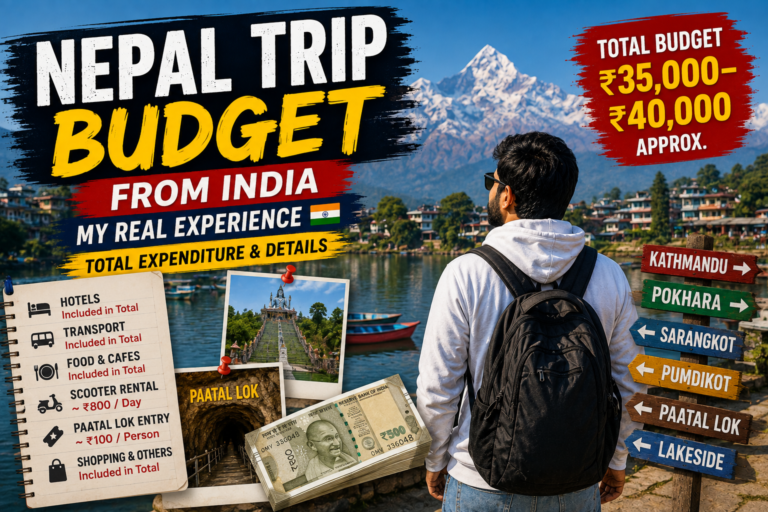
No Plan to 7 Days Travel of Nepal
I had absolutely no plan to visit Nepal.
There was no itinerary, no hotel booking, no detailed research, and honestly, I didn’t even know where in Nepal we were going.
I had simply packed a normal 3–5 day travel bag and reached Anand Vihar, Delhi.
My plan was just to go somewhere for a few days.
| खर्च | Approx. Amount (₹) |
|---|---|
| Delhi → Mahendranagar Bus | ₹1,600 |
| Mahendranagar → Kathmandu Bus | ₹2,000 |
| Kathmandu Hotels – 2 Nights | ₹4,000 |
| Kathmandu Local Transport / Cabs | ₹1,000 |
| Kathmandu Food & Drinks | ₹2,500 |
| Kathmandu Sightseeing / Tickets | ₹2,050 |
| Kathmandu → Pokhara Transport | ₹1,600 |
| Pokhara Hotels – 3 Nights | ₹5,000 |
| Pokhara Local Transport / Cabs | ₹1,000 |
| Scooter Rental – 1 Day | ₹1,600 |
| Petrol | ₹500 |
| Pokhara Food & Drinks | ₹3,500 |
| Pokhara Sightseeing / Tickets | ₹500 |
| Shopping / Souvenirs | ₹1,500 |
| Pokhara → India Border Transport | ₹2,000 |
| Border → Delhi Bus | ₹2,200 |
| Miscellaneous / Snacks / Other Expenses | ₹2,000 |
| Estimated Total | ₹32,550 |
Maybe Shimla.
Maybe Banaras.
Maybe somewhere else.
We were checking buses and talking about where we could go when, completely randomly, we noticed a bus going from Delhi to Nepal.
That’s where this trip changed.
I didn’t even know that I could simply take a bus from Delhi toward Nepal like this.
We asked about the ticket.
Then came the obvious question:
“But we don’t have passports.”
We were told that for our situation, Indian citizens could travel with accepted identification documents rather than a passport.
We looked at each other.
And basically thought:
“Chalo Nepal chalte hain.”
And that’s how our completely unplanned Nepal trip began.
From Moradabad to Anand Vihar
I started my journey from Moradabad, Uttar Pradesh.
My travel partner was already in Delhi.
So I travelled from Moradabad to Delhi and met him at Anand Vihar.
At that point, we still hadn’t decided where we were going.
We were literally looking at different buses.
We considered places like:
- Shimla
- Prayagraj
- Varanasi
- Other nearby destinations
We were simply looking for somewhere we could spend a few days.
Then we noticed something completely unexpected.
A Delhi-to-Nepal bus was standing there.
Neither of us had Nepal properly planned.
We didn’t know which city we’d visit.
We didn’t know where we’d stay.
And we didn’t even know where the bus would actually drop us.
But we asked about the ticket anyway.
The Random Decision to Go to Nepal
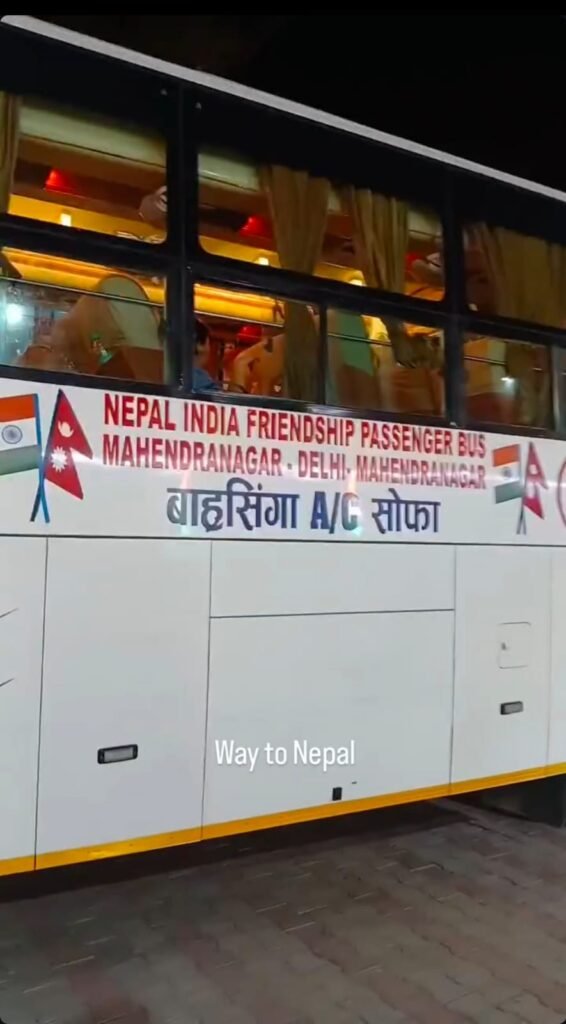
The bus was heading toward Mahendranagar, in western Nepal.
The bus operator told us that if we boarded, we’d reach Mahendranagar early the next morning.
The bus was comfortable and had sofa-style seats.
Our ticket from Delhi to Mahendranagar cost around ₹800 per person.
We had some basic snacks with us, including peanuts and other things to eat during the journey.
And that’s it.
No detailed itinerary.
No hotel reservations.
No proper Nepal research.
Just two people who had decided:
“Let’s see what happens.”
Our First Night on the Bus
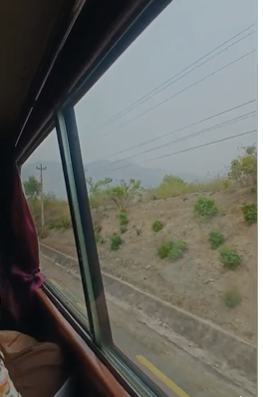
We boarded the bus and started our journey from Delhi.
There were quite a few Nepali passengers travelling on the bus.
We ate some snacks, relaxed in our seats, and eventually fell asleep.
I remember thinking that we still didn’t really know what was going to happen the next morning.
We didn’t know where we’d stay.
We didn’t know how we’d reach Kathmandu.
We barely knew anything about Nepal beyond one famous name:
Kathmandu.
That’s literally how little planning we had done.
Reaching Mahendranagar
We reached Mahendranagar early in the morning, around 5–6 AM.
The first thing we did was ask people:
“Kathmandu kaise jaana hai?”
People told us that buses were available from the local bus area.
But there was one problem.
The next direct bus wasn’t leaving immediately.
We had several hours to kill.
So we decided to find somewhere to sit, eat breakfast, and rest.
Our First Nepali Breakfast
This was also our first proper introduction to Nepali food.
We ordered breakfast locally and started trying things like:
- Momos
- Chowmein
- Nepali-style meals
- Other local dishes
And suddenly the trip started feeling real.
We were no longer sitting in Delhi thinking about where to go.
We were actually in Nepal.
A Cheap Room in Mahendranagar
Because we had several hours before our bus, we asked around for a room.
A local person helped us find a basic room for around ₹200–₹300.
It wasn’t luxurious.
It wasn’t particularly comfortable either.
It was hot, and the room was very basic.
But for a few hours of rest, it worked perfectly.
That’s one thing I learned during this trip:
When you’re travelling without a plan, you learn to adjust.
You don’t always get the perfect room or perfect transport.
You simply figure it out.
Changing Indian Rupees to Nepali Currency
Before continuing toward Kathmandu, we also exchanged money.
We gave around ₹10,000 Indian currency and received approximately NPR 16,000 according to the exchange we got at that time.
I also bought a Nepal Telecom Namaste SIM because we knew we’d need mobile data for maps, bookings, and communication.
That turned out to be one of the most useful things we bought.
Mahendranagar to Kathmandu
Our Kathmandu bus was a sleeper-style bus.
The ticket cost around NPR 1,000 per person.
We boarded around the afternoon and finally started the long journey toward Kathmandu.
This was when Nepal started looking completely different.
Outside the window, we started seeing:
- Mountains
- Rivers
- Green landscapes
- Hills
- Small settlements
- Winding roads
Our seats were beside the window, so we spent a lot of the journey simply looking outside.
The journey was long, but the scenery made it worthwhile.
My First Impression of Rural Nepal
One thing I noticed during the journey was the contrast between different areas.
Some places looked quite underdeveloped compared with major Indian cities.
Roadside facilities were basic.
Even some toilet stops required payment.
But at the same time, the natural scenery was beautiful.
Mountains would suddenly appear.
Then a river.
Then a valley.
Then small houses scattered across the hills.
It felt completely different from the urban environment I was used to.
And that contrast became one of the most interesting parts of the trip.
Finally Reaching Kathmandu
After a long journey, we finally reached Kathmandu.
We were exhausted.
And, once again, we had no idea what to do next.
We had a hotel to find, transport to arrange, and an entire city to figure out.
We asked locals about taxis and ride apps.
We were told about services such as inDrive and other local options.
We tried booking a car, but getting a driver to accept wasn’t always easy.
Eventually, we found a local ride for around NPR 300.
That ride took us to our hotel.
Our Kathmandu Hotel
We had booked our Kathmandu accommodation online after checking reviews.
The room cost around NPR 2,000 per night.
For the price, I found it quite comfortable.
We had:
- A proper room
- TV
- Multiple beds
- A decent view
- Basic facilities
It was a huge improvement compared with our basic room in Mahendranagar.
After the long journey, we finally had somewhere comfortable to rest.
Our First Evening in Kathmandu
By the time we settled into the room, it was already evening.
I wasn’t feeling particularly well either.
So we didn’t immediately start sightseeing.
Instead, we went outside and explored the nearby market.
We asked locals what we should see in Kathmandu.
That’s when we started hearing names like:
- Pashupatinath Temple
- Thamel
- Kathmandu Durbar Square
- Swayambhunath Stupa
We had heard of Pashupatinath before.
But most of the other places were completely new to us.
Kathmandu Felt Different
One of the first things I noticed was the weather.
India was relatively hot at the time, while Kathmandu felt noticeably cooler.
The temperature was much more comfortable.
Another thing that surprised me was how often the weather could change.
It could be perfectly normal one moment and then suddenly start raining.
That happened several times during our Nepal trip.
You really had to be prepared for unpredictable weather.
Nepali Food and Indian Food
During our first evening, we tried local food.
We ate momos and other snacks.
But later, we also ordered Indian food.
Interestingly, we found an Indian person from Bihar living nearby who offered to help us with food whenever we needed it.
That became a nice little connection during the trip.
And honestly, after eating local food for a while, sometimes you just want a proper Indian meal.
My First Big Kathmandu Experience: Pashupatinath
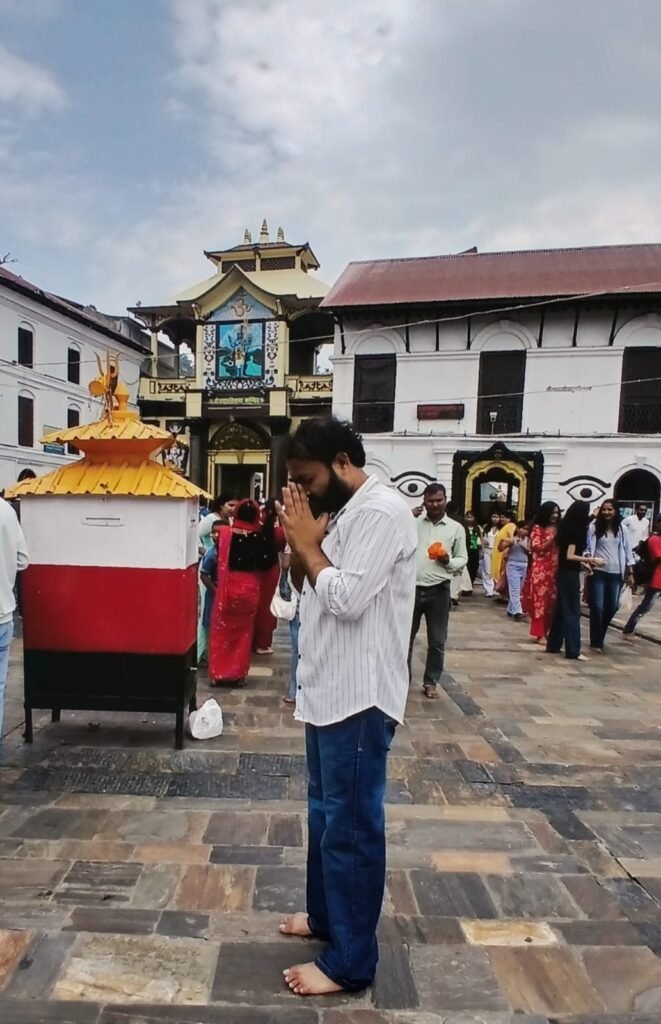
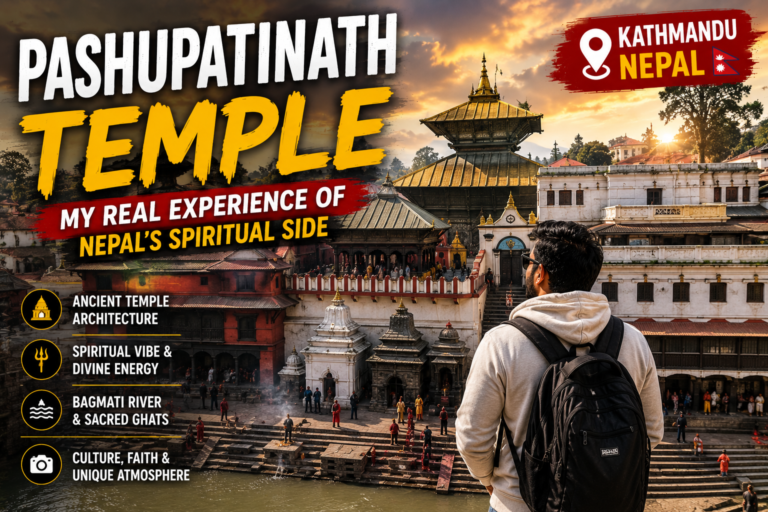
The next morning, we decided to visit Pashupatinath Temple.
The temple was around 2.5 kilometres from our hotel, so we decided to walk.
We could have taken a vehicle.
But walking allowed us to see more of Kathmandu along the way.
We eventually reached the temple area.
And that’s when the atmosphere changed completely.
Inside Pashupatinath Temple
Before entering the main temple area, we had to leave our shoes and follow the temple’s rules.
Photography and video were restricted in the main temple area.
You could take photos around certain outside areas, but the main sanctum was not a place for filming.
The temple complex itself was much larger than I had imagined.
There were many people visiting, including a large number of Indian devotees.
But what stayed with me wasn’t just the size or the crowd.
It was the atmosphere.
There was something difficult to describe about standing there.
The chants, the temple environment, the people, the rituals—it created a completely different feeling.
I remember getting goosebumps.
For a moment, I wasn’t thinking about travel content, photos, or social media.
I was simply standing there and taking it all in.
The Ghats Behind Pashupatinath
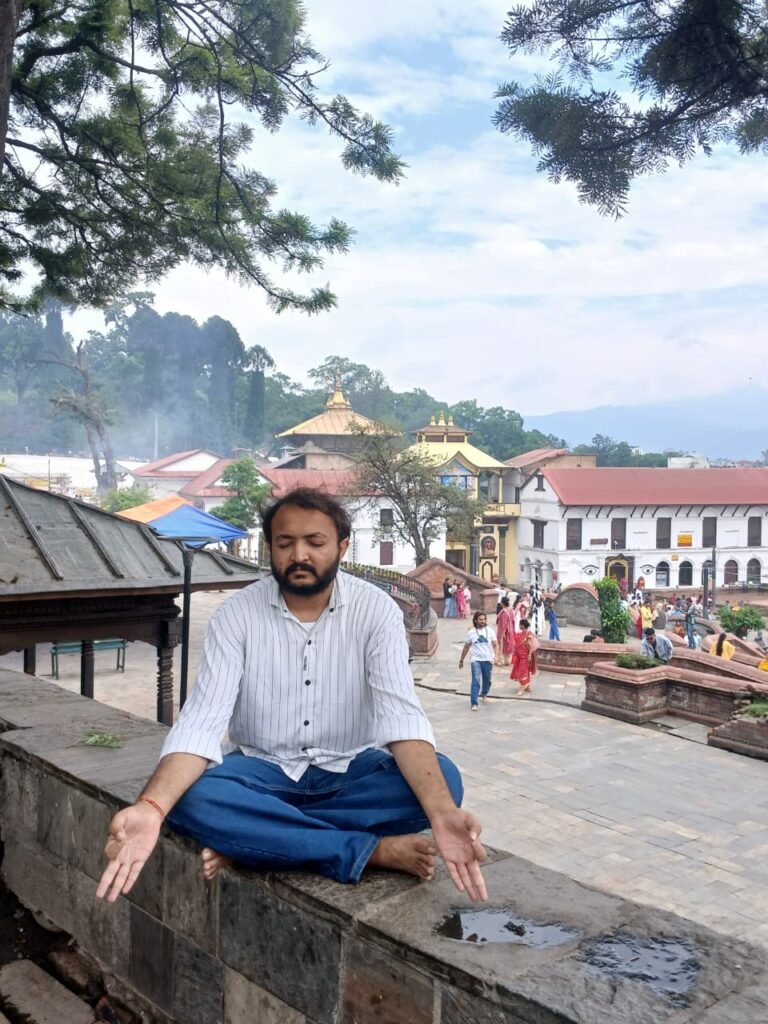
Behind the temple area, we saw the cremation ghats along the river.
Funeral pyres were burning.
It reminded me of the atmosphere around the ghats in Varanasi.
We sat there for some time and simply watched.
And honestly, that moment changed something in my thinking.
I started thinking:
What are we actually taking with us from this life?
We spend so much time fighting.
We worry about money.
We worry about status.
We worry about what other people think.
But eventually, everyone reaches the same destination.
Sitting there made me think about my own life.
What have I actually done?
And more importantly:
What do I want to do from here?
The Idea Behind My Blog
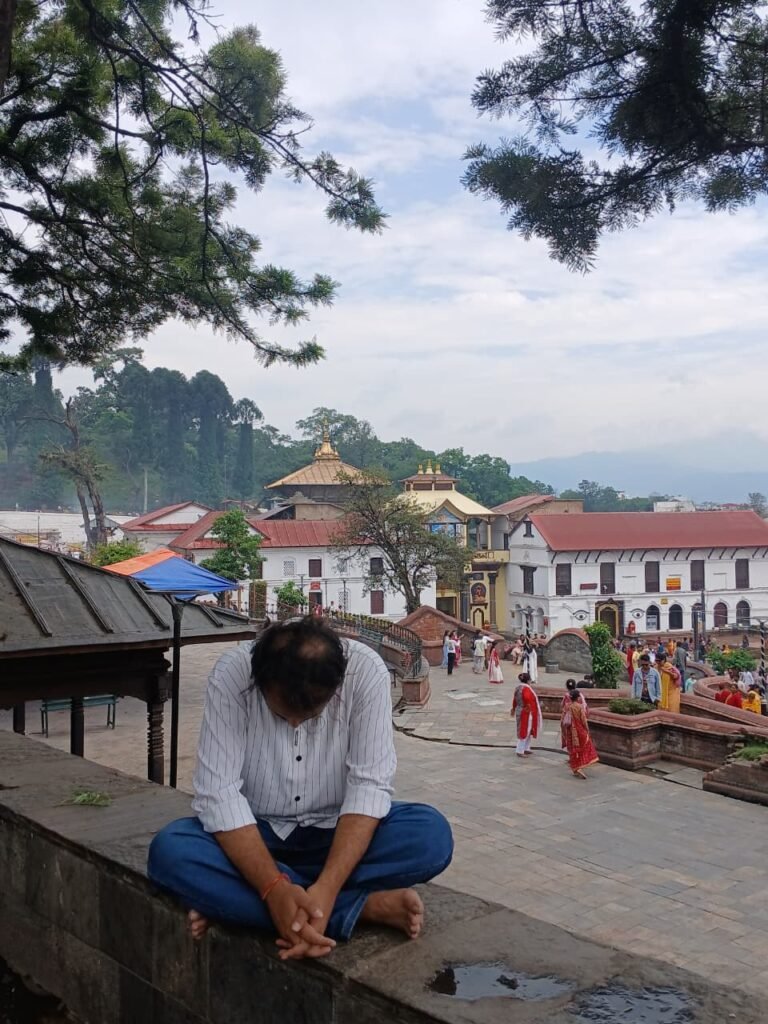
That was probably the most important moment of my entire Nepal trip.
While sitting near the ghats, I suddenly thought:
Why don’t I start my own blog?
Why not share my real travel experiences?
Why not tell people what I actually experienced instead of simply posting random photos?
I wanted to document:
- Places I visit
- People I meet
- Mistakes I make
- Things I learn
- Travel experiences
- Real costs
- Things I wish I’d known earlier
And most importantly, I wanted to tell people:
Life isn’t just about somehow getting through the days.
If you have the opportunity, travel.
Meet people.
See new places.
Try new things.
Experience the world.
Because eventually, the memories you create are worth far more than many of the things we spend our entire lives chasing.
Meeting People in Nepal
One thing I genuinely loved about Nepal was meeting people.
We spoke to locals.
We met Indians travelling there.
People shared recommendations with us.
They told us about:
- Kathmandu
- Pokhara
- Muktinath
- Local food
- Transport
- Hotels
- Places worth visiting
A lot of our trip actually developed through conversations.
That’s how we eventually heard about Pokhara.
Until then, we hadn’t even planned to go there.
And that’s the funny thing about this trip.
Every major part of our itinerary came from somewhere we discovered along the way.
Exploring Kathmandu After Pashupatinath
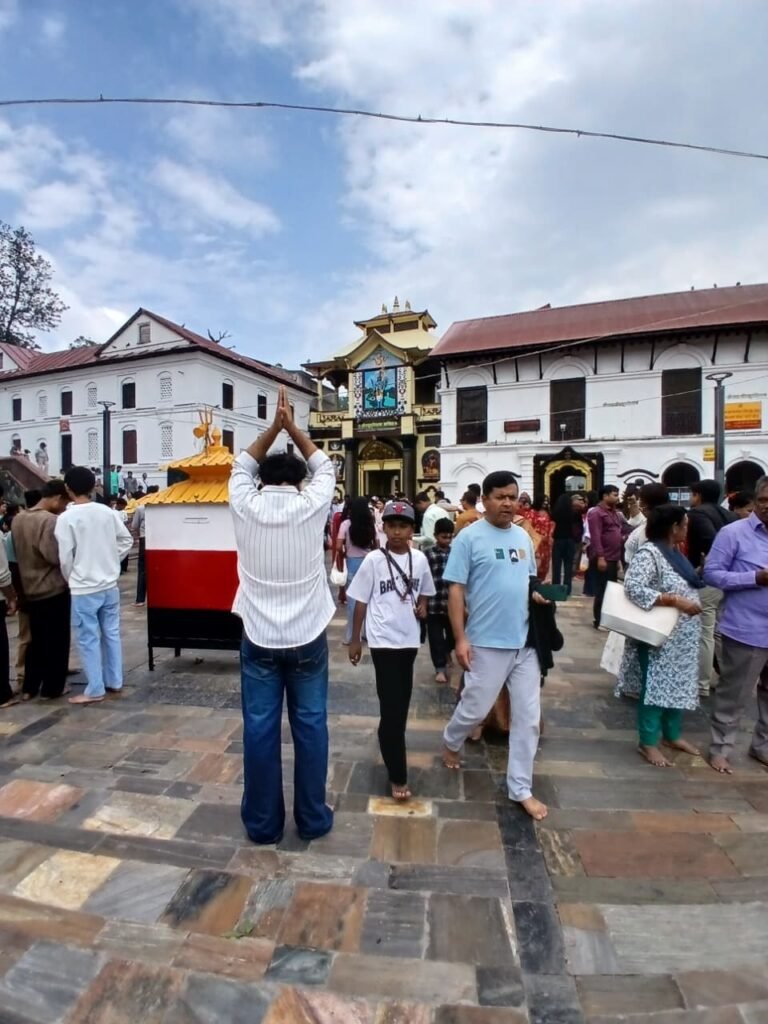
After spending time at Pashupatinath and having that unexpectedly deep moment at the ghats, we went back toward our hotel.
My health wasn’t great that day either. I was having stomach pain and didn’t feel like walking too much.
We rested for a while and later decided to go out again.
This time, we wanted to see what Kathmandu looked like in the evening.
Kathmandu’s Streets and Local Markets
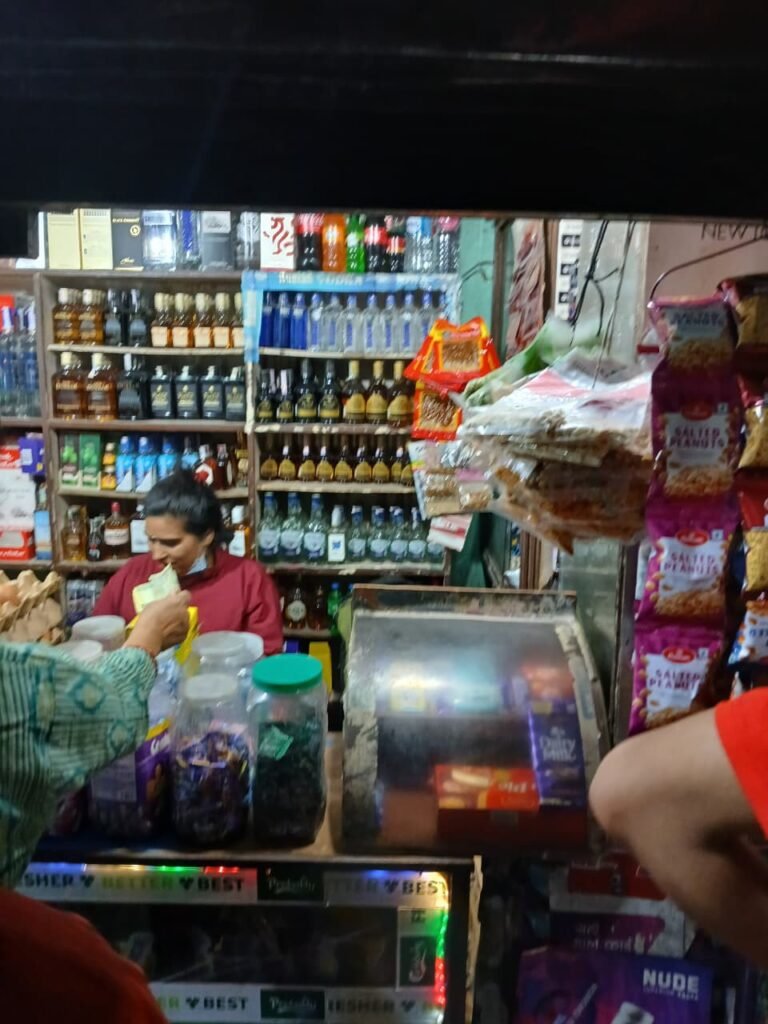
We walked around the nearby markets and started talking to people.
Everyone had different suggestions about where we should go.
Some recommended Thamel.
Others suggested the different Durbar Squares and Buddhist sites around Kathmandu.
That’s when we realized that Kathmandu had far more to explore than we had originally imagined.
We had arrived knowing almost nothing about the city.
Now we had a growing list of places.
Kathmandu’s Cleanliness Surprised Me
One thing I noticed repeatedly during my stay was how clean many parts of Kathmandu felt.
Roads, markets, hotels, and public areas often looked well maintained.
Even the washrooms we used during sightseeing were surprisingly clean.
Of course, not every area was perfect, but overall, the level of cleanliness genuinely impressed me.
It made me think about something simple:
A city doesn’t become better only because it becomes richer.
People’s habits matter too.
If people dispose of waste properly, keep public areas clean, and take responsibility for their surroundings, the entire city feels different.
That was one of the things I appreciated most about Nepal.
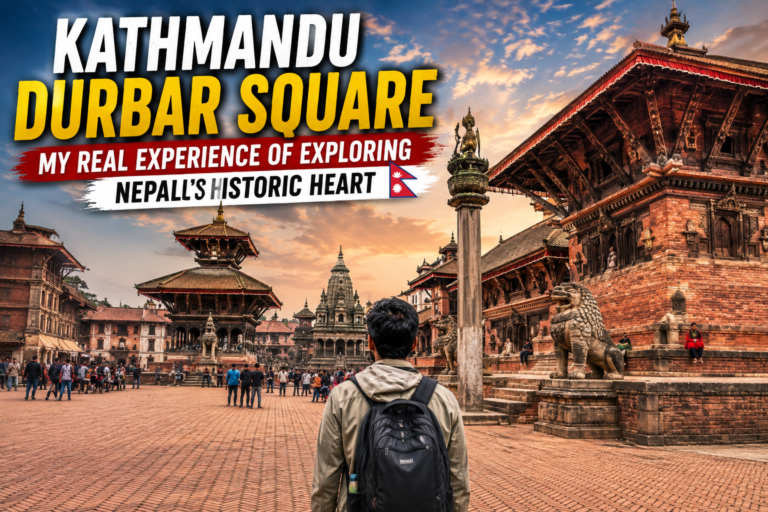
Kathmandu Durbar Square
Eventually, we decided to visit Kathmandu Durbar Square.
We took a cab and made our way there.
The area had historic buildings, temples, courtyards, and traditional architecture.
There was an entry ticket, and we paid roughly NPR 1,000 based on what I remember from our visit.
Honestly, I had expected something more dramatic.
The place was interesting historically, but compared with some of the other experiences we had in Nepal, it didn’t leave the strongest impression on me.
What did stand out was the architecture and the sense that you were walking through a place with a lot of history.
Getting Around Kathmandu
For most of our local travel, we used ride-hailing apps and cabs.
inDrive was particularly useful for us.
But one thing we learned quickly was:
Don’t blindly accept the first price someone gives you.
Negotiation was often necessary.
Sometimes a short ride could become surprisingly expensive if you didn’t ask the price beforehand.
So whenever you’re travelling around Kathmandu, check the distance, compare options, and negotiate when appropriate.
Thamel: The Complete Opposite Vibe
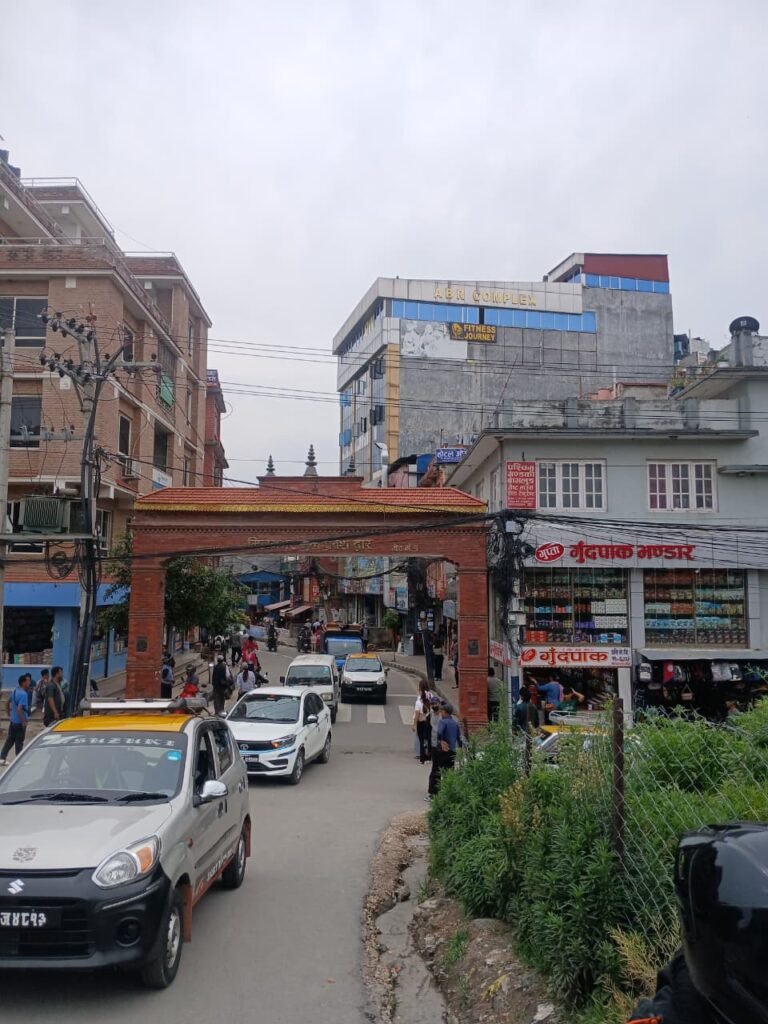
After Durbar Square, we headed toward Thamel.
And wow.
The atmosphere changed completely.
If some parts of Kathmandu felt peaceful and spiritual, Thamel felt energetic.
There were:
- Bright lights
- Cafés
- Restaurants
- Shops
- Bars
- Clubs
- Street vendors
- Tourists everywhere
The streets were packed.
There were Indians, Europeans, Nepali locals, backpackers, couples, and groups of friends.
It felt like Kathmandu’s nightlife center.
Shopping in Thamel
We also did a little shopping.
I bought a cotton kurta-pajama.
We also bought a small Nepal-themed magnet as a souvenir.
And here’s something I learned quickly:
Bargaining is important.
I managed to get the kurta-pajama and another item for around NPR 1,000 after bargaining.
If you’re shopping in tourist markets, don’t immediately accept the first price.
Ask.
Compare.
Negotiate politely.
You may get a much better deal.
Our First Unexpected Club Experience
We weren’t actually planning to go clubbing.
But because the trip was so spontaneous, we ended up entering a club in Thamel.
At first, I went inside alone.
The atmosphere was strange because there were people trying to interact with customers and encourage them to spend money.
It felt very commercial.
As soon as my travel partner joined me, the situation changed and we moved on.
I wasn’t in Nepal specifically for that kind of experience.
I wanted to see the country, meet people, eat local food, and explore.
So we decided not to spend much time there.
A Better Evening at a Café
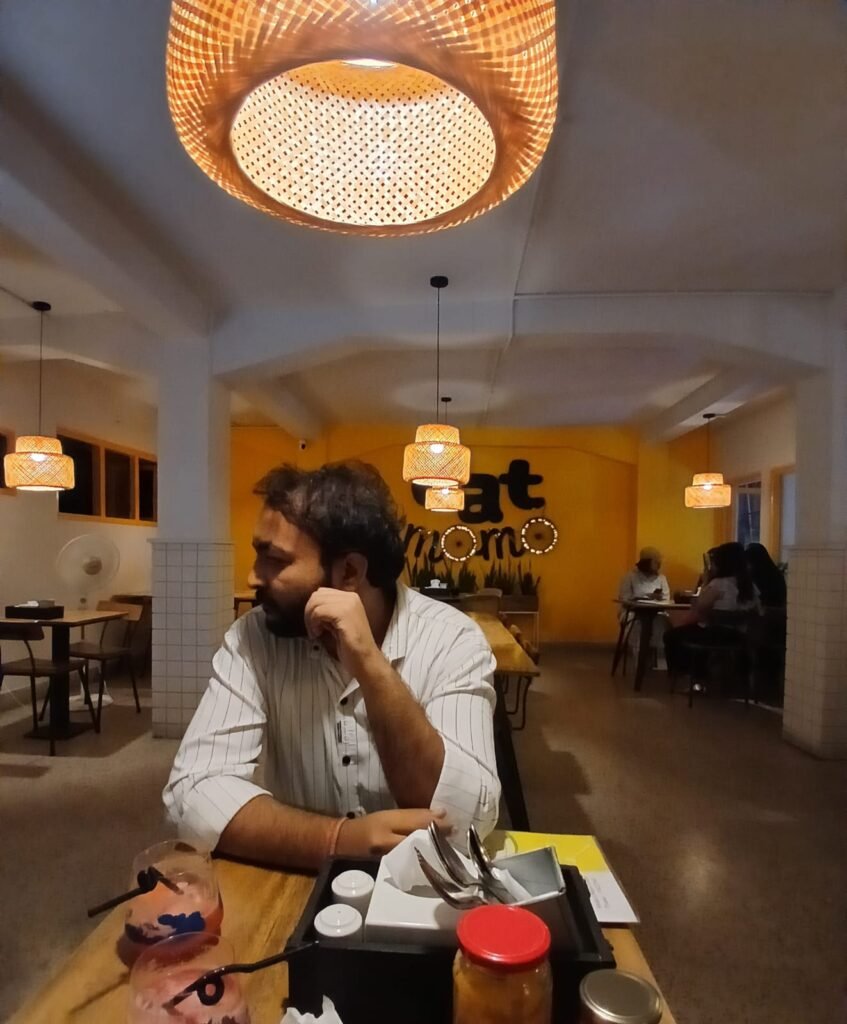
Instead, we found a café and ordered momos and juice.
I remember trying green-colored momos for the first time.
They looked completely different from the regular momos I was used to.
The café was nice, and the total bill came to around NPR 1,000.
It was more expensive than our basic local meals, but the atmosphere was enjoyable.
We sat, talked, took some photos, and watched the market around us.
The Strange Experience at Our Hotel
Later that night, we returned to our hotel.
There were people drinking downstairs.
My travel partner went down to collect our food and encountered some uncomfortable behavior from a group of people staying there.
They made inappropriate comments and asked personal questions.
It completely changed the mood.
We weren’t expecting that kind of environment.
The next morning, we spoke with the hotel staff about what had happened.
They told us that many of those people were Indian tourists.
That experience reminded me of something important:
A place isn’t represented by every tourist who visits it.
We had met many genuinely kind and helpful Nepali people.
One uncomfortable experience shouldn’t define an entire country.
Our Morning in Kathmandu
The next morning, we checked out.
Before leaving, we had breakfast from a small Indian food place nearby.
The uncle running it was from India and was extremely friendly.
He even gave us his phone number and told us to contact him whenever we needed food.
Those small interactions were becoming some of our favorite memories.
Swayambhunath Stupa
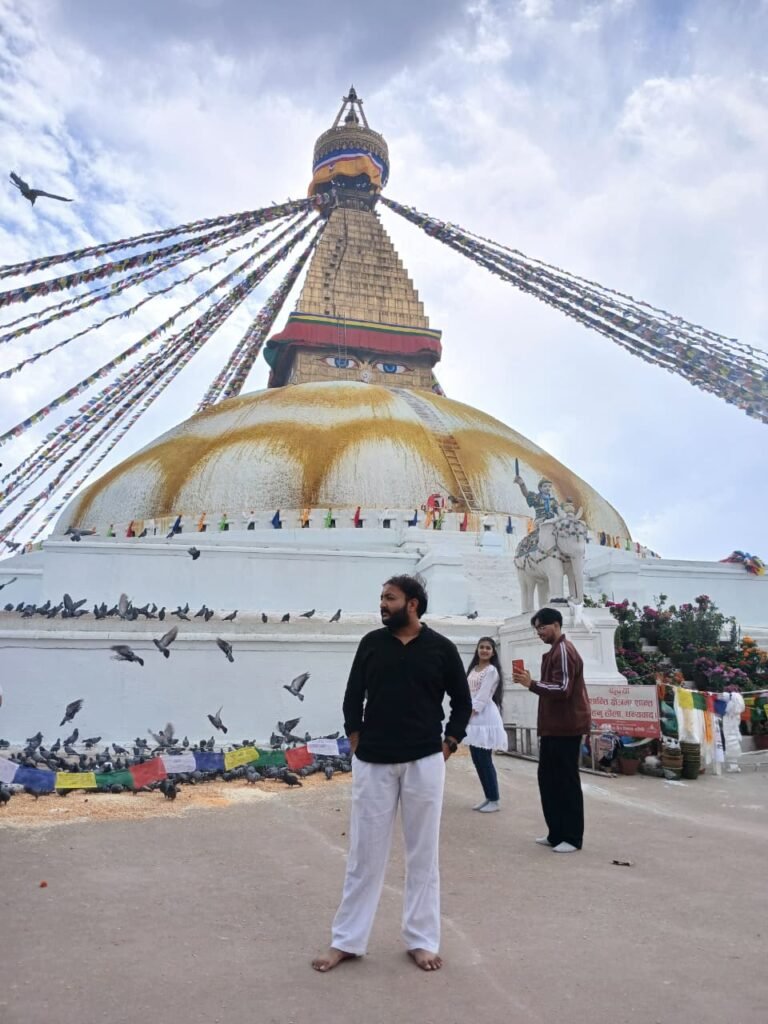
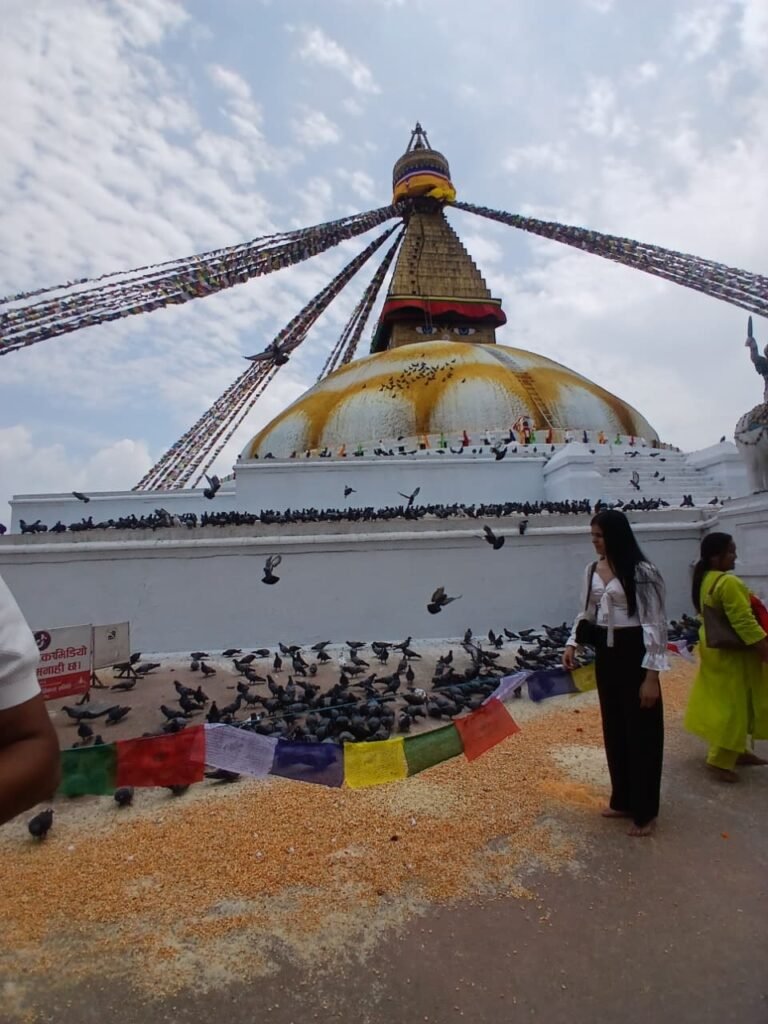
We then decided to visit Swayambhunath Stupa, commonly known as the Monkey Temple.
The entry fee for Indian visitors was around NPR 25 per person during our visit.
Compared with some other attractions, it was extremely affordable.
We climbed up and reached the stupa area.
And once again, the atmosphere changed.
There were people walking around the stupa, taking photos, praying, and quietly enjoying the surroundings.
The View From Swayambhunath
The view was one of my favorite parts.
From up there, you could see Kathmandu spreading across the valley.
There were buildings, hills, greenery, and the city stretching into the distance.
We took plenty of photos and videos around the permitted areas.
There were also pigeons flying around, which made for some really nice photo moments.
The combination of the stupa, mountains, cityscape, and birds created a very peaceful scene.
Meeting More Locals
While exploring the area, we spoke to several people.
That’s when someone suggested:
“You should go to Pokhara.”
Until then, Pokhara wasn’t really part of our plan.
But everyone kept talking about it.
They told us about:
- Phewa Lake
- Sarangkot
- Paragliding
- Mountain views
- Lakeside cafés
- Peaceful surroundings
And we thought:
Why not?
Our trip was already completely unplanned.
So we decided to add another city.
Kathmandu to Pokhara
We asked around about buses to Pokhara.
Someone directed us to the place where we could find transport.
We initially thought we’d get a normal bus.
Instead, we found a van.
The driver told us that this was the available option.
So we got in.
And this became one of the craziest transport experiences of the entire trip.
The Most Crowded Van Journey
There were around 15 people packed into the van.
It was seriously crowded.
There wasn’t much personal space.
But everyone around us was surprisingly friendly.
We spoke with other passengers and asked them about Nepal.
One person even told us about Muktinath and shared information about where we could go and stay.
The people around us were constantly helping each other.
That became a recurring theme of our Nepal trip.
A Long Journey to Pokhara
We started the journey during the morning.
The road gradually changed as we moved deeper into the hills.
We stopped at a few places for breaks.
The scenery kept getting better.
Mountains appeared.
Then valleys.
Then winding roads through the hills.
The journey was long and exhausting.
We eventually reached the outskirts of Pokhara at around 10–11 PM.
So what should have been a simple journey became an entire day of travelling.
Arriving in Pokhara Late at Night
Once we reached Pokhara, another problem appeared.
We tried booking a cab online.
But drivers weren’t accepting our requests.
We eventually found one driver who accepted.
The fare was around NPR 350.
A fellow traveller who had been travelling with us also helped us.
He gave us his number and told us to contact him if we needed help.
These small acts of kindness made a huge difference because we were arriving in an unfamiliar city late at night.
Our First Pokhara Hotel
We had booked a hotel online.
The price was reasonable—roughly around NPR 1,600–1,800, based on the booking.
But there was a problem.
The room we had booked had apparently been given to someone else because our reservation hadn’t been properly confirmed.
We had specifically paid extra because we wanted a room with a view.
The hotel owner apologized and helped us find another room nearby for the night.
It wasn’t perfect.
But it worked.
And Then We Saw the View
The next day, we finally understood why everyone had been telling us to visit Pokhara.
Our room had a view of Phewa Lake.
There were mountains all around.
Small houses were spread across the hills.
The lake sat in front of us.
And the entire landscape looked like a postcard.
I remember sitting there eating breakfast and thinking:
“Yaar, yahin ghar bana loon.”
Just sit here.
Eat breakfast.
Look at the mountains.
Look at the lake.
And live peacefully.
After all the travelling, that moment felt incredible.
Our Pokhara Plan Changed Again
We had originally booked two days.
But after seeing the view, we decided to extend our stay.
We ended up spending around three days in Pokhara.
And instead of immediately running around to every attraction, we did something very different.
We simply stayed.
We enjoyed the hotel.
We enjoyed the view.
We ate breakfast.
And we rested.
Sometimes the best part of travelling is not rushing to the next attraction.
It’s sitting somewhere beautiful and doing absolutely nothing.
Nepal Trip Part 3: Pokhara, Lakeside, Sarangkot, Pumdikot & Our Journey Back to India
After Kathmandu, we finally reached Pokhara—and honestly, this was the part of Nepal that impressed me the most.
We had come to Nepal without a proper plan, but by this point we had learned one thing:
Just ask people.
Almost everyone had some suggestion about where to go next.
And Pokhara turned out to be completely different from Kathmandu.
Our First Proper View of Pokhara
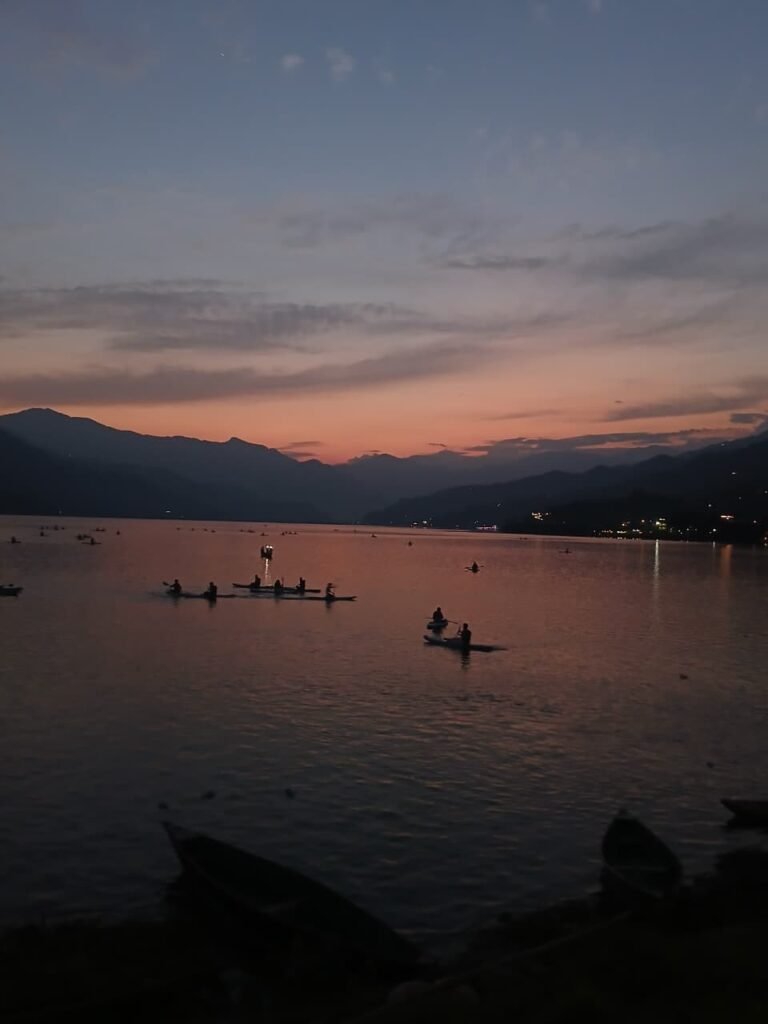
The hotel we stayed in had an incredible view.
Right outside our room was Phewa Lake.
On the other side were mountains and small houses scattered across the hills.
The whole view looked like something from a travel postcard.
We had a sitting area where we could simply sit, eat breakfast and look at the lake.
There was no need to go anywhere.
We were so tired from the previous journeys that, for one entire day, we basically stayed around the hotel and enjoyed the view.
At one point I genuinely thought:
“Yaar, yahin room leke ghar basa lete hain.”
Wake up, look at the lake, eat breakfast, enjoy the mountains and live peacefully.
That was the vibe.
Exploring Lakeside Pokhara
Later that evening, we finally decided to go for a walk.
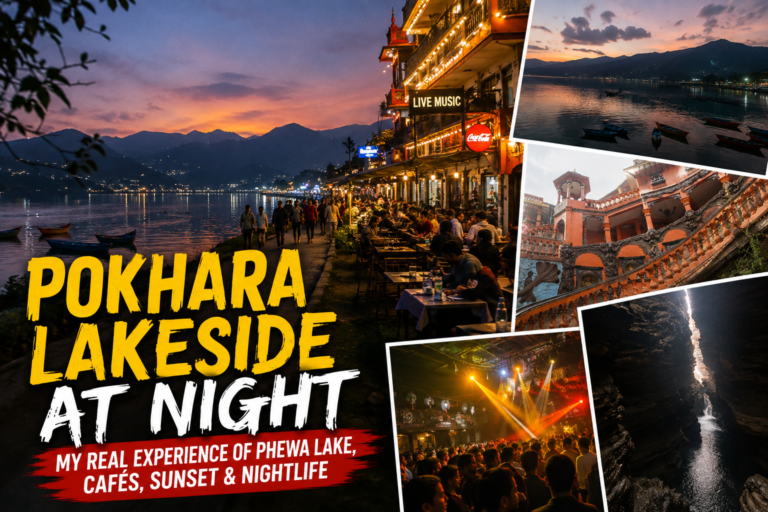
Pokhara has a beautiful Lakeside walking area around Phewa Lake.
And this walk became one of my favorite experiences of the entire trip.
One side had the lake.
The other side had cafés, restaurants and shops.
There were beautiful lights everywhere.
Live singing was happening at cafés.
People were sitting outside, drinking, eating and talking.
There were tourists from different countries, Indians, Nepali locals and travellers from all over.
The atmosphere was incredibly relaxed.
Sunset Over Phewa Lake
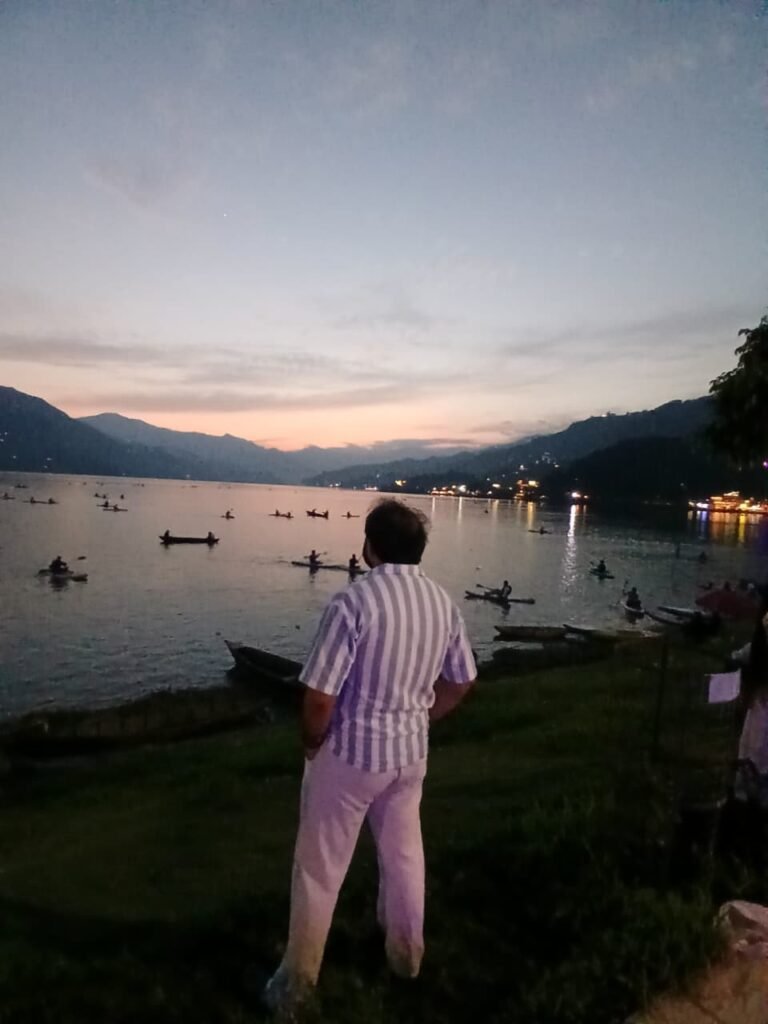
While we were walking, the sun started setting.
People were boating on the lake.
The mountains were visible in the background.
The cafés were glowing with lights.
And the whole place slowly started becoming more beautiful as evening arrived.
We took photos and videos and just sat there for a while.
Honestly, I remember thinking:
“Goa se bhi better vibe aa rahi hai yahan.”
It didn’t feel like a typical crowded tourist destination.
It felt like a peaceful hill station mixed with a lively international backpacker town.
Lakeside at Night
As it got darker, the whole Lakeside area became even more lively.
There were cafés everywhere.
People were sitting outside listening to live music.
Some were having drinks.
Others were simply walking along the lake.
We also sat at a couple of cafés and enjoyed the live singing.
And one thing that stood out again was the cleanliness.
People were enjoying themselves, but the public spaces were still relatively clean.
That made the whole experience much better.
The Peaceful Side of Pokhara
We weren’t interested in rushing from one attraction to another.
We wanted to actually experience the place.
So we sat beside the lake.
We spoke with other Indian travellers.
We talked to locals.
We watched people boating.
And we simply enjoyed the atmosphere.
Sometimes travelling isn’t about checking ten places off a list.
Sometimes it’s just about sitting somewhere beautiful and thinking:
“Life is actually pretty good.”
Catwalk Club
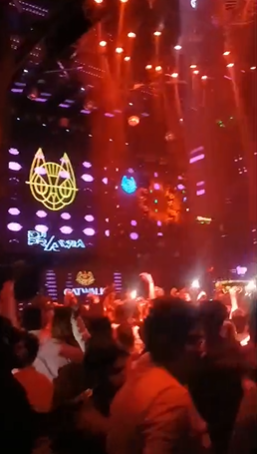
Later, we decided to experience Pokhara’s nightlife.
Someone recommended Catwalk Club.
The club reportedly opened around 11 PM and continued through the night.
When we first went out, though, it looked completely empty.
It was around 10 PM and the streets were surprisingly quiet.
We thought:
“Is everything closed today?”
But as we got closer to the nightlife area, we started seeing more cafés and people.
We waited until the nightlife actually started.
Entering the Club
The club had a proper entrance system.
We paid around NPR 500 per person for entry.
Inside, there was a large dance floor and a stage.
The crowd gradually became bigger.
There were Indian tourists as well as Nepali people.
Some people had booked tables, while others were standing near the dance floor.
We didn’t book a table.
We just wanted to dance and experience the atmosphere.
And eventually, we started enjoying ourselves.
A Night of Dancing
We had a few drinks and danced.
We also met some Indian travellers there and had conversations with them.
It was actually a much better experience than the first club experience we had in Kathmandu.
The atmosphere felt more relaxed.
We stayed for a while and eventually left around 1–2 AM.
Walking back through the streets at that hour was interesting.
During the daytime, some parts of the area looked almost empty.
But at night, the same streets were full of lights and nightlife.
Pokhara basically has two personalities.
Quiet hill town by day.
Lively tourist town at night.
Late-Night Momos
After leaving the club, we were hungry.
We didn’t really want to eat expensive food inside the club.
So we searched for a café that was still open.
We found one that was close to closing.
We ordered momos and a cold drink.
We had limited cash with us because we’d left some money back at the hotel.
So we kept things simple.
Just enough food to satisfy the hunger.
While we were there, we started talking to the girl working the night shift and the owner.
They were incredibly friendly.
We talked about India and Nepal.
The girl told us that she didn’t particularly want to work in India because she felt uncomfortable about safety and culture there.
That conversation honestly made me think.
Here was someone working a night shift, confidently going home late at night, while we were constantly thinking about safety.
It made me realize how differently people experience the same things depending on where they live.
Renting a Scooter in Pokhara
The next morning, we decided we wanted to explore Pokhara independently.
So we rented a scooter.
The cost was around ₹800 in Indian currency for one day.
The rental company took our identification documents and other details before giving us the scooter.
Finally, we were ready.
No cab.
No bus.
No driver.
Just us and a scooter.
Heading Towards Sarangkot
We decided to visit Sarangkot first.
We were told it was around 7–8 kilometres from Pokhara.
The road gradually became more mountainous.
There were steep climbs, winding roads and beautiful views.
When we reached the higher areas, the view completely changed.
Below us was the valley.
We could see the lake.
The city looked tiny from above.
Mountains surrounded the landscape.
And the whole place looked incredible.
Paragliding in Sarangkot
Sarangkot is also famous for paragliding.
We could actually see people flying over the valley.
There were also adventure activities around the area.
We considered trying it.
But my travel partner was nervous about paragliding.
And we were already running short on time.
We still had other places to visit.
So we decided:
“Next time.”
It’s probably one of the few things from the trip that I genuinely wish we’d tried.
The Temple Above Sarangkot
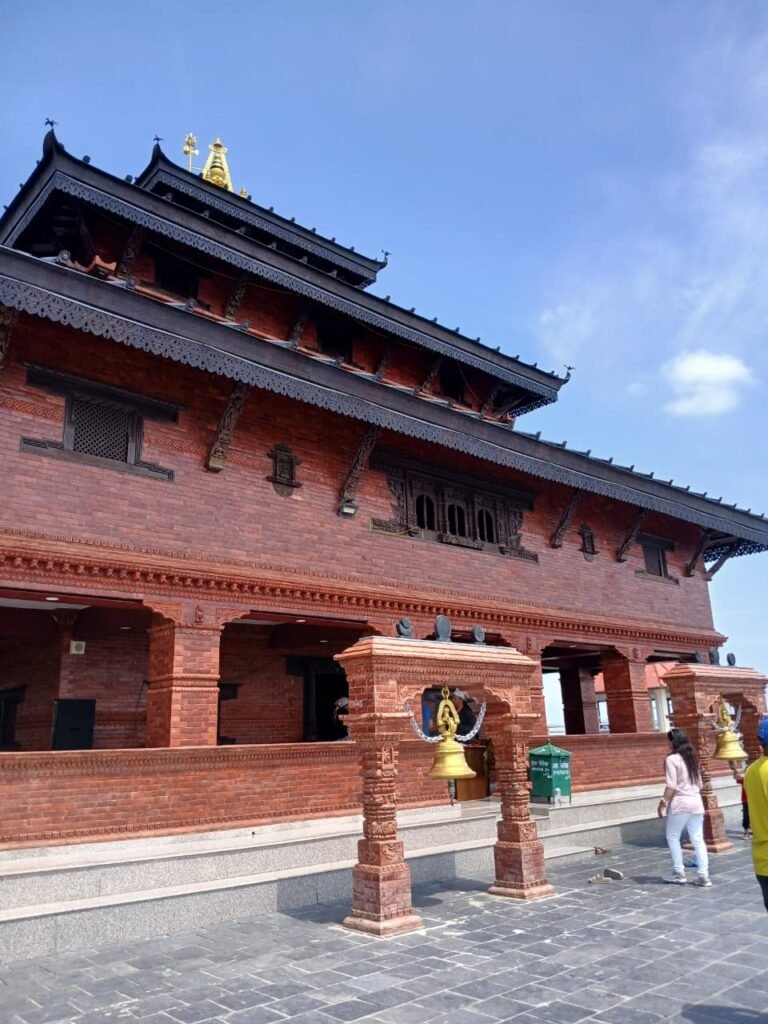
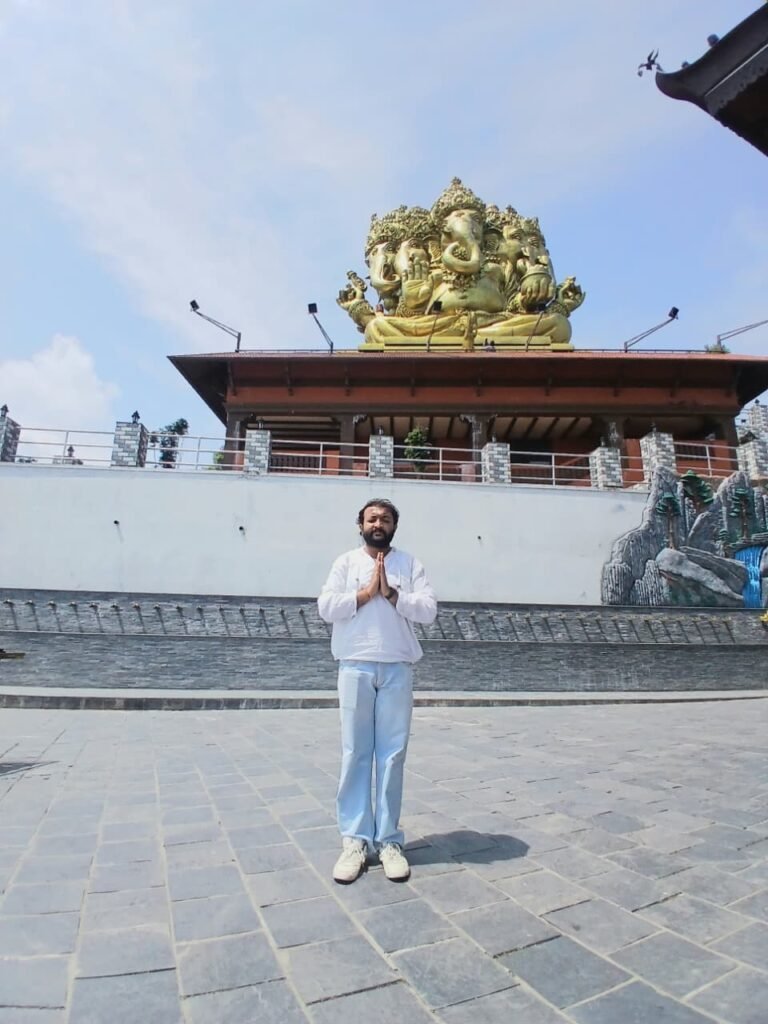
We continued higher and found a large temple area with a huge Ganesh statue.
The climb required walking up a number of stairs.
Before climbing, we stopped to eat something.
We ordered chana and some other snacks.
Then came the climb.
And honestly…
After eating, climbing those stairs was a terrible idea.
Our stomachs were full.
Our legs were tired.
And halfway up, we were wondering:
“Bhai, aur kitna upar jaana hai?”
But eventually we reached the top.
A Beautiful Temple View
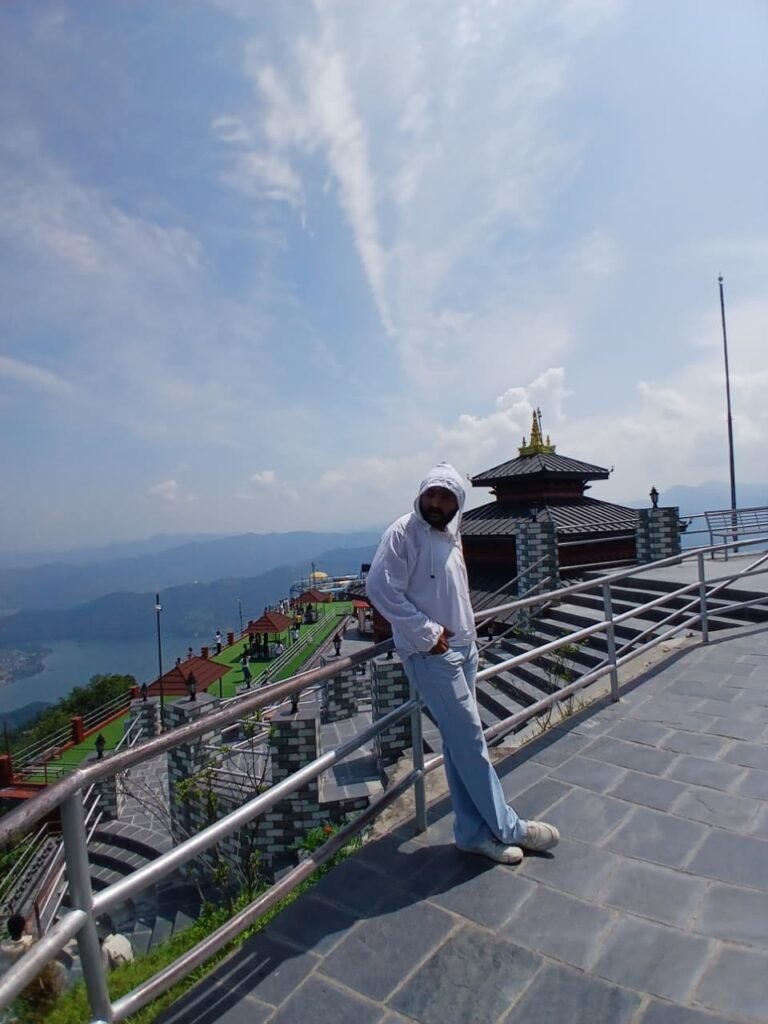
The temple itself had a very peaceful atmosphere.
There was a priest inside.
The architecture had a traditional Nepali feel, with the distinctive roof structure.
There was also a green carpeted area where visitors could sit and relax.
People were taking photos, talking quietly and enjoying the view.
We sat there for a while too.
After all the climbing, simply sitting down and feeling the mountain air was fantastic.
Pumdikot
After Sarangkot, we decided to head toward Pumdikot.
It was on the opposite side and roughly 12 kilometres away.
We had already filled petrol in the scooter.
So we started riding through the hills.
Some roads were steep and difficult.
We even ended up taking a less convenient route because we didn’t know the area properly.
But that’s the funny thing about an unplanned trip.
Sometimes the wrong road becomes part of the adventure.
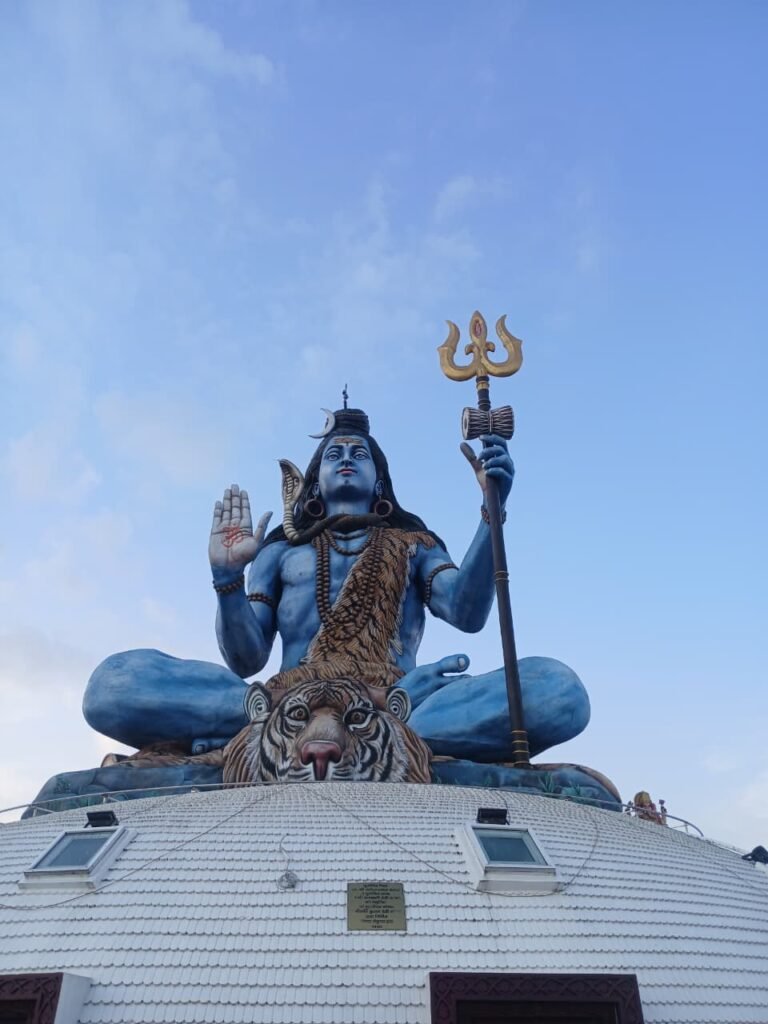
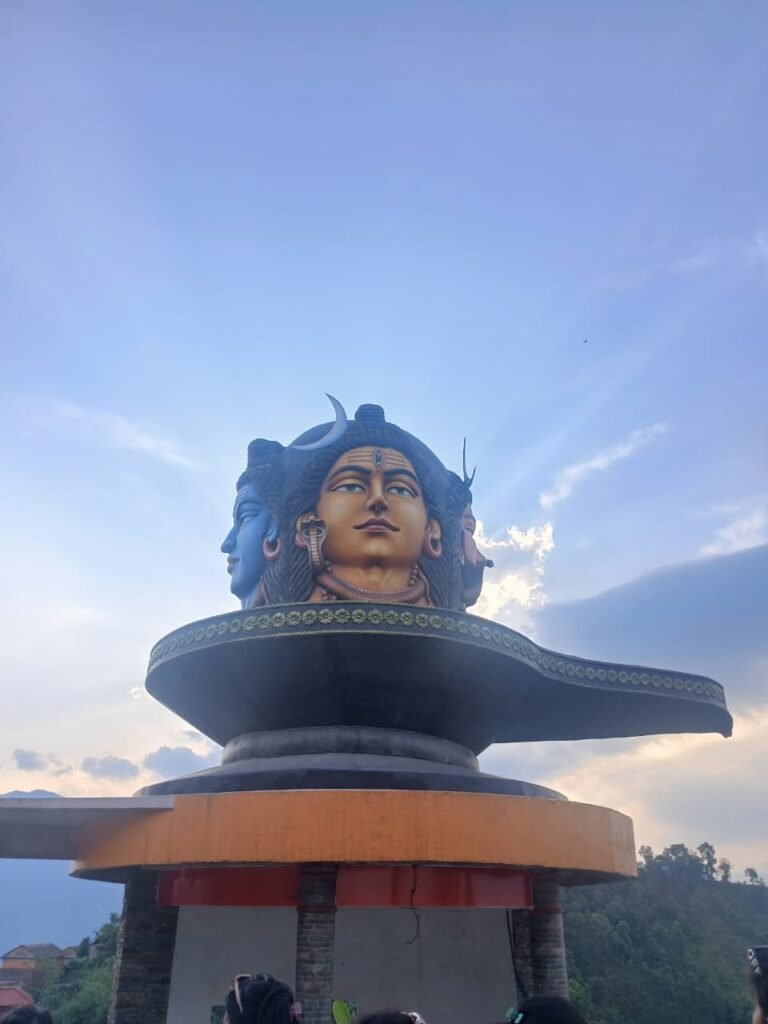
The Giant Shiva Statue
When we finally reached Pumdikot, one thing immediately caught our attention:
The enormous Shiva statue.
It was huge.
And behind it were mountains.
The combination of the giant Shiva statue and the Himalayan landscape was incredible.
We parked the scooter and walked upward.
There were shops and places selling snacks, walnuts and other local products.
The climb was tiring, but the view made it worthwhile.
The View From Pumdikot
Once we reached the upper area, the landscape opened up.
Mountains were visible in the distance.
The valley stretched below.
And behind the Shiva statue, the mountains created an incredible backdrop.
We took plenty of photos.
We also explored the temple area.
There were several religious structures and places where people could sit and relax.
The whole place had a very strong spiritual atmosphere.
Nepal’s Religious Culture
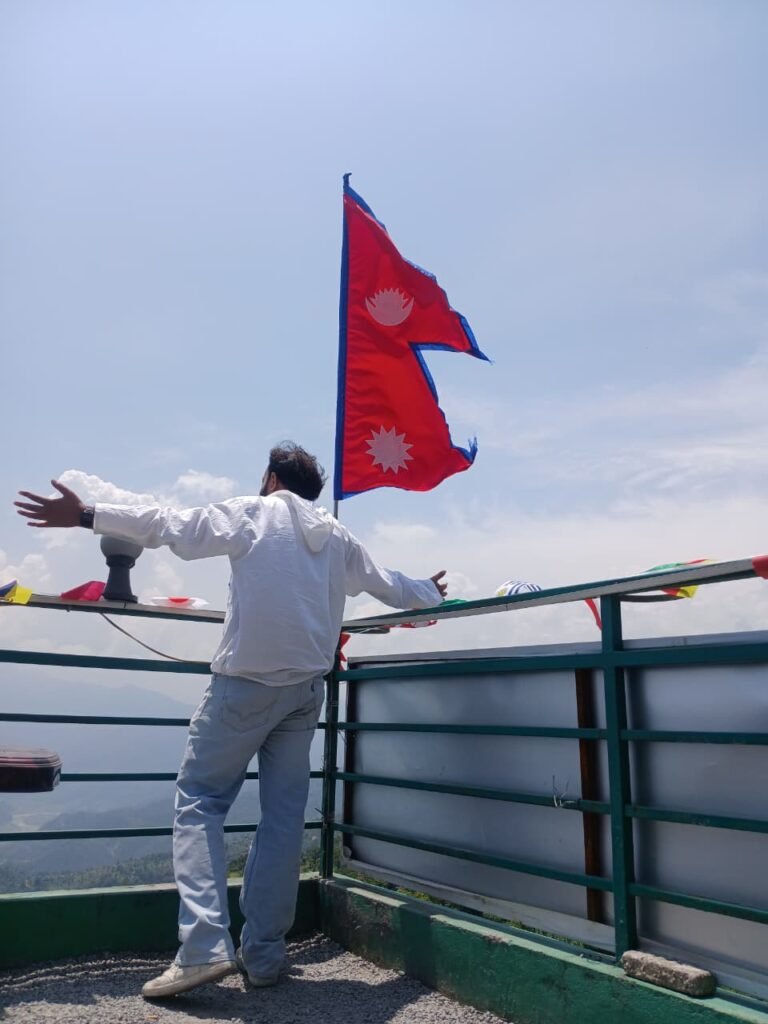
Something I noticed throughout the entire trip was how important religion and spirituality were to many people.
From Pashupatinath to the stupas, temples and Shiva statues, religion wasn’t simply something tourists came to see.
It was part of everyday life.
People were praying.
People were visiting temples with their families.
People were making offerings.
And the atmosphere was generally peaceful.
That was one of the things I found fascinating about Nepal.
A Different View of Mountain Life
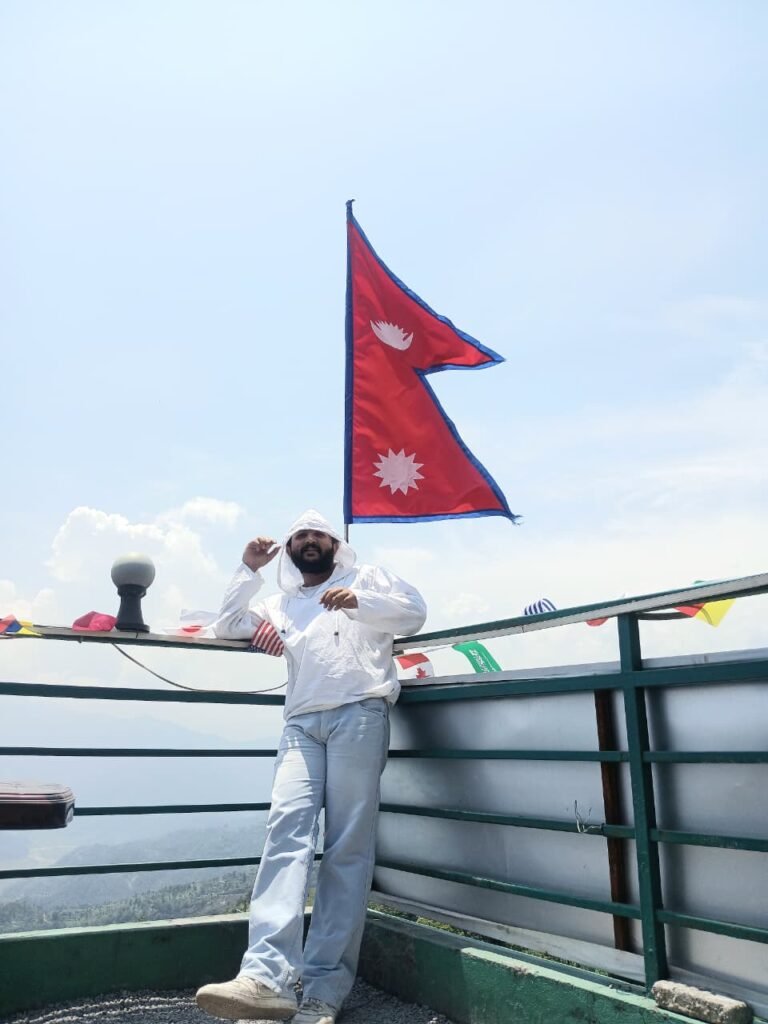
On our way back down, we saw local people collecting water from mountain water sources.
Some children were carrying water back home.
We stopped and spoke with some locals.
That’s when we understood something that tourists often don’t see.
From the outside, mountain life looks beautiful.
We look at the mountains and think:
“What an amazing life.”
But actually living there can be extremely difficult.
Water isn’t always readily available.
Supplies have to be transported uphill.
Roads can be difficult.
Schools and other facilities aren’t always nearby.
Everything requires effort.
The beautiful mountain view comes with a very different lifestyle.
And that really stayed with me.
Returning the Scooter
By the time we returned the scooter, it was already getting late.
We returned the scooter and collected our security deposit.
Then we asked about transportation back toward India.
And that’s when we discovered another problem.
The direct bus we wanted had already left.
We were exhausted.
It was getting late.
And we still had to figure out how to get home.
The Journey Back to India
We asked around and were told that we might have to travel toward the Indian border first rather than getting a direct bus to Delhi.
So we took a local bus.
The journey was long and uncomfortable.
The bus stopped repeatedly.
Eventually, we were taken toward the Nepal-India border.
Along the way, we saw another side of Nepal.
The major tourist areas had cafés, hotels and developed infrastructure.
But outside the main cities, facilities were much more basic.
Restaurants and roadside stops were limited.
Life looked much simpler.
Crossing the Nepal-India Border
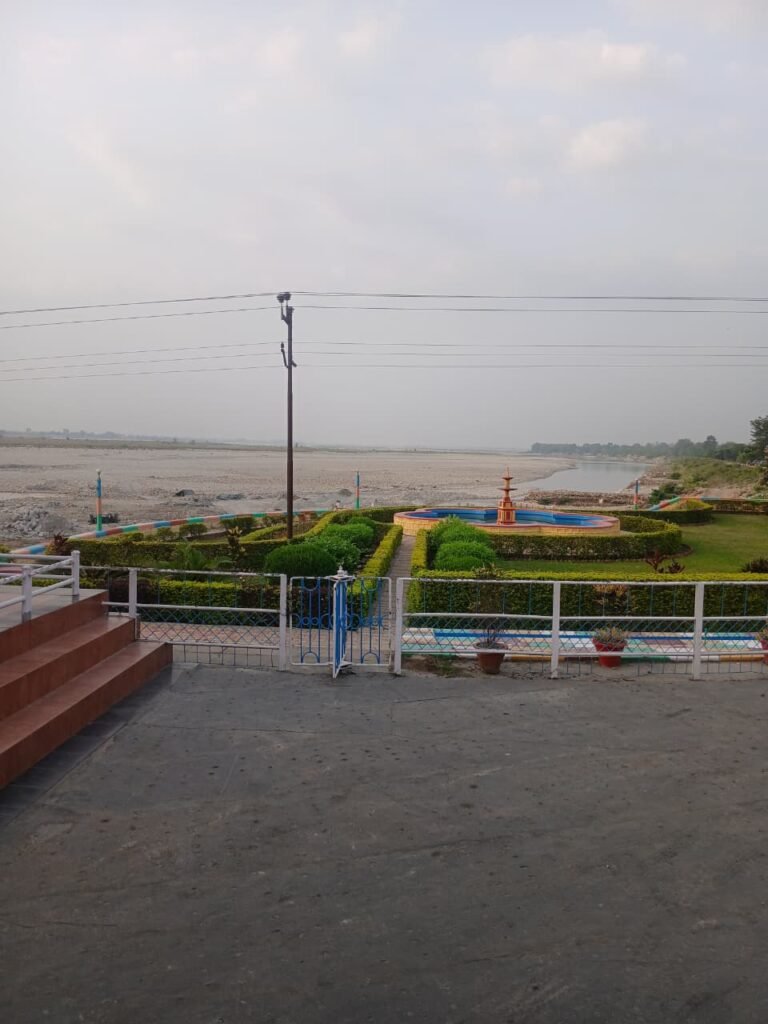
We reached the border in the evening.
Before crossing, we stopped to eat something.
We had some chowmein and other snacks.
One thing we noticed throughout Nepal was that Indian currency was widely accepted in many places we visited.
That made things much easier for us.
At the border, security checks were carried out.
We showed our identification documents.
The security personnel were actually extremely helpful.
We asked them:
“Delhi ke liye bus kahan se milegi?”
One of the security personnel helped us find a bus.
He didn’t simply point us toward a bus.
He actually helped us get a reasonably priced ticket.
Our ticket was around ₹2,200 for the journey toward Delhi.
The Overnight Bus to Delhi
The bus was full of Nepali passengers.
Many of them were travelling onward for international flights or to visit family abroad.
We ended up sitting toward the back.
The passengers were incredibly helpful.
We asked them about the journey.
They asked us about our trip.
And again, strangers were helping strangers.
That became one of the biggest themes of our Nepal experience.
Returning to India
The bus travelled overnight.
We stopped around Mathura in the morning and had breakfast.
Eventually, we reached Delhi in the afternoon.
After such a long trip, stepping off the bus in Delhi felt strange.
We had started this journey with almost no plan.
And somehow we’d travelled through:
Delhi → Mahendranagar → Kathmandu → Pokhara → Indian border → Delhi.
Our Total Nepal Trip Budget
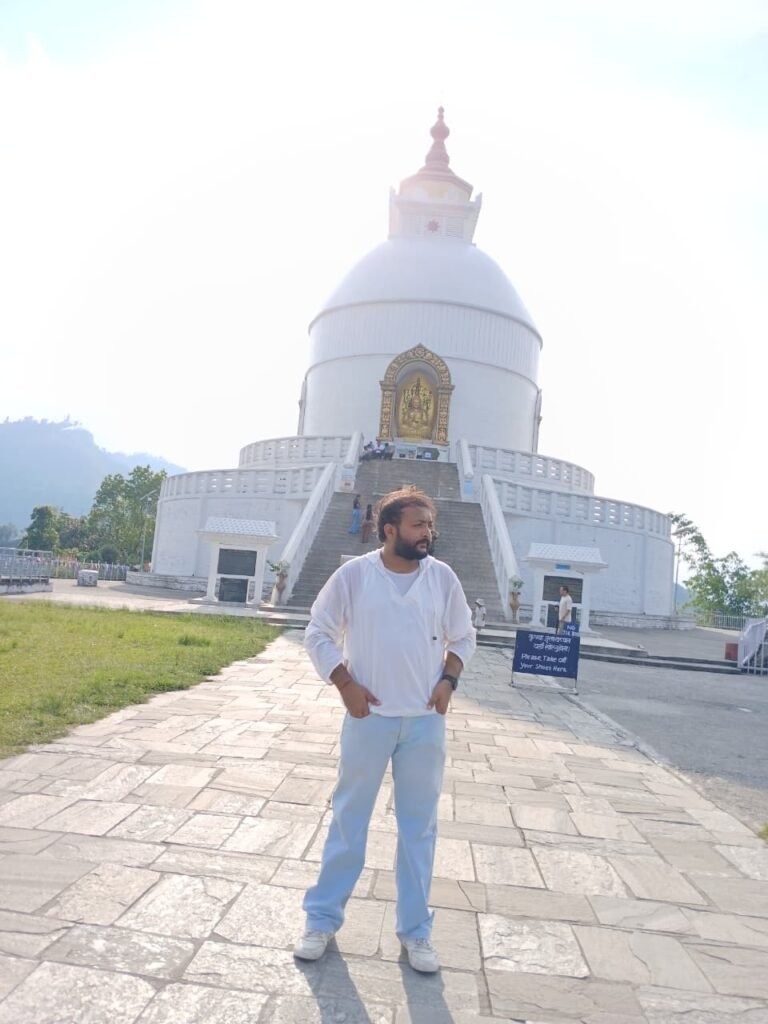
When I added everything together, our overall trip cost came to roughly:
₹35,000–₹40,000
That included our major travel expenses, accommodation, food, local transport, sightseeing, shopping and other expenses during the trip.
And honestly, considering how much we experienced, I felt it was completely worth it.
What I Learned From Nepal
The biggest lesson wasn’t about temples.
It wasn’t about mountains.
It wasn’t even about travelling cheaply.
It was about people.
We met strangers who helped us.
People gave us directions.
People recommended places.
People shared their experiences.
People helped us find transport.
People even shared their phone numbers so we could contact them later.
And that made the trip feel much more personal.
Nepal Isn’t Just About Mountains

Before visiting Nepal, I thought the country was mainly about mountains and temples.
But after travelling through it, I realized it’s much more than that.
It’s:
Kathmandu’s spirituality.
Thamel’s nightlife.
Pokhara’s lake.
Sarangkot’s mountains.
Pumdikot’s giant Shiva statue.
Small roadside cafés.
Local people.
Unexpected conversations.
Long bus journeys.
And all those unplanned moments in between.
My Biggest Takeaway
One thought kept coming back to me from the moment I sat near the cremation ghats at Pashupatinath.
Life is short.
We’re always worrying about money, jobs, status, arguments and what other people think.
But eventually, none of that matters.
So if you have the opportunity to travel, go see the world.
Meet people.
Try different food.
Get lost sometimes.
Take the wrong bus.
Walk through unfamiliar streets.
Sit beside a lake.
Watch a sunset.
Climb a mountain.
Talk to strangers.
And create memories.
Because sometimes the best trips are the ones you didn’t plan.
And Nepal was exactly that for me.
A completely unplanned journey that turned into one of the most memorable trips of my life.
Also See related Article The Ultimate Goa Travel Guide (2026): Budget, Itinerary, Hotels, Beaches, Food & Hidden Places, Goa Scooter Rental Guide (2026): Cost, Documents, Tips & My Experience, Goa Food Guide (2026): 20 Must-Try Goan Dishes & What I Ate on My Trip, Goa Itinerary for 7 Days (2026): My Complete Day-by-Day Travel Plan & Budget Guide, How to Plan a Budget Trip to Goa (2026): My Complete Guide Under ₹25,000