When people plan a Nepal trip, they usually spend most of their time researching places to visit.
Which mountain?
Which lake?
Which viewpoint?
Which café?
Which temple?
But one thing that can quietly make or break a trip is where you stay.
We learned this during our own Nepal journey.
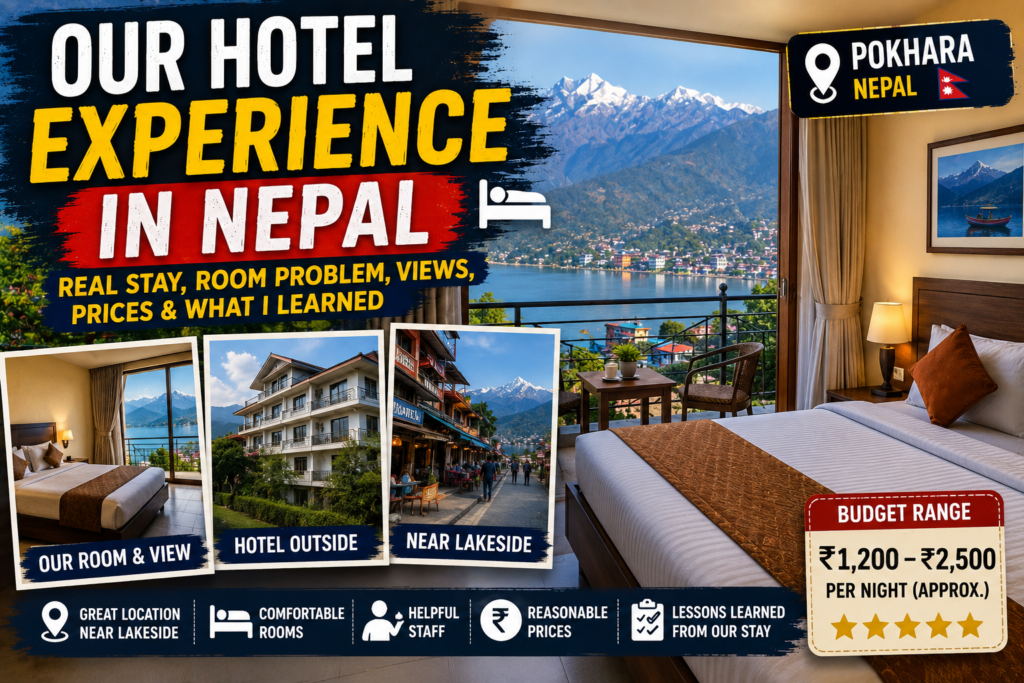
Our hotel experience was mostly comfortable, but we also had one situation where the room we had booked wasn’t available when we arrived. Fortunately, the hotel owner helped us find another room nearby, so the problem didn’t become a major issue.
That experience made me realize something: a hotel can look perfect online, but your actual experience starts only after you reach the property.
In this article, I’m sharing our hotel and accommodation experience in Nepal—not as a generic hotel guide, but as something based on what actually happened during our trip.
Our Hotel Experience at a Glance
| Factor | Our Experience | My Rating |
|---|---|---|
| Hotel availability | Generally manageable | ⭐⭐⭐⭐ |
| Online booking | Useful, but one booking issue happened | ⭐⭐⭐½ |
| Price | Reasonable options were available | ⭐⭐⭐⭐ |
| Room experience | Mostly comfortable | ⭐⭐⭐⭐ |
| Location | Important for exploring | ⭐⭐⭐⭐½ |
| Views | A major factor for us | ⭐⭐⭐⭐ |
| Hotel staff | Helpful when we had a problem | ⭐⭐⭐⭐½ |
| Value for money | Good overall | ⭐⭐⭐⭐ |
| Booking reliability | Could have been better | ⭐⭐⭐½ |
| Overall stay experience | Positive | ⭐⭐⭐⭐ |
These ratings are based entirely on our personal experience, not a ranking of hotels in Nepal.
We Didn’t Want a Luxury Hotel
When we planned our Nepal trip, we weren’t looking for an expensive luxury stay.
Our priority was simple.
We wanted a place that was:
- Comfortable
- Reasonably priced
- Conveniently located
- Clean enough
- Suitable for resting after a long day
- Ideally offering a good view where possible
We weren’t going to spend a huge portion of our travel budget just for a fancy room.
After all, we were travelling to Nepal to explore.
We knew we’d spend most of the day outside.
So for us, the hotel needed to be a comfortable base, not the main attraction.
Why Location Mattered More Than Luxury
One thing I would definitely prioritize again is location.
A slightly better room isn’t always worth it if you’re staying far away from everything.
During our time in Pokhara, being around the Lakeside area was especially useful.
We could go out in the evening.
We could explore cafés.
We could walk around.
We could experience the nightlife.
And we didn’t have to spend a huge amount of time travelling just to get back to the hotel.
That’s something I learned during the trip:
A good location can save you both time and energy.
Our Hotel Booking Experience
We did use online platforms to check hotels.
It was convenient because we could compare different properties, look at photographs and understand what kind of rooms were available.
But our experience also showed us why you shouldn’t rely completely on an online booking.
We had booked a particular room.
And the room we wanted had a view, which was important to us.
When we arrived, however, the room we had booked wasn’t available because of a booking-related issue.
Obviously, that wasn’t what we expected.
After travelling, the last thing you want is to arrive at a hotel and discover that your room isn’t available.
Fortunately, the Hotel Owner Helped Us
Thankfully, the situation didn’t turn into a major problem.
The hotel owner helped us arrange another room nearby.
It wasn’t exactly the original situation we had planned for, but at least we had a solution.
This actually changed my perspective on hotel problems.
The booking issue itself was frustrating.
But the way the person handled the situation mattered.
Instead of simply saying, “Your room isn’t available,” they helped us find an alternative.
And because of that, the overall experience remained positive.
What I Would Do Differently Now
If I were booking the same trip again, I’d still use online platforms.
They’re extremely useful for researching hotels.
But after making an important booking, especially for a room with a specific feature, I would confirm directly with the hotel before arriving.
I’d confirm:
- Room type
- Number of guests
- Availability
- View, if promised
- Check-in time
- Any special requirements
It takes only a few minutes.
And it can potentially prevent a lot of frustration after a long journey.
Why We Cared About the View
For us, the view wasn’t just a luxury.
We were in Nepal.
We were surrounded by mountains.
So naturally, having a room where we could see the surroundings was something we wanted.
Imagine spending the entire day exploring mountains and lakes and then returning to a room where you can still look outside and see the landscape.
That’s part of the experience.
Of course, a view isn’t guaranteed just because a hotel advertises one.
Buildings, weather and room location can all make a difference.
But when you’re travelling somewhere as scenic as Nepal, it’s worth considering.
Hotels in Nepal Can Be Reasonably Priced
One thing we found during our trip was that reasonably priced accommodation was available.
You don’t necessarily have to book an expensive hotel to have a comfortable stay.
There are different categories of accommodation, and your choice depends on your budget.
If you’re travelling like us—spending most of the day outside—you may not need a luxury property.
A clean, comfortable room in a convenient location can be enough.
But Don’t Choose Only by Price
This is another lesson I learned.
The cheapest hotel isn’t automatically the best hotel.
You need to consider what you’re actually getting.
For example:
A hotel might be cheap but far away from the main area.
Another might cost slightly more but save you money on local transport.
A cheaper room might have no view.
A slightly more expensive room might have the location you want.
So don’t look at the room price in isolation.
Look at the overall value.
Our Hotel Was More Than Just a Room
During a long trip, your hotel becomes a place where you reset.
You come back after walking.
You come back after riding a scooter.
You come back after exploring a cave.
You come back after spending an evening around Lakeside.
You shower.
You rest.
You charge your phone.
You organize your bags.
And then you go out again.
That’s why comfort matters.
Even if you’re not spending much time there, you need a place where you can actually recover.
After a Long Day in the Mountains
Our days around Pokhara could be tiring.
We were riding scooters.
Walking around.
Climbing stairs.
Exploring places.
And sometimes travelling through mountain roads.
After a day like that, you don’t necessarily want a fancy hotel.
You simply want to get back, take a shower and relax.
That’s why I think travellers sometimes overthink hotel selection.
You don’t always need luxury.
You need the right hotel for your travel style.
The Difference Between a Tourist Hotel and a Travel Base
For us, the hotel was essentially our travel base.
We weren’t there to spend the entire day.
We were there to sleep, rest and prepare for the next adventure.
That’s very different from a resort holiday.
If you’re planning to spend most of your time inside the property, then hotel facilities become much more important.
But if you’re exploring Nepal all day, location and comfort may matter more.
Our Pokhara Stay Worked Well for Our Travel Style
Pokhara was especially good for this.
We wanted to explore Lakeside.
We wanted to visit cafés.
We wanted to experience nightlife.
We wanted to ride towards Sarangkot.
We wanted to visit Pumdikot.
And we wanted to explore Paatal Lok.
So staying somewhere convenient helped us move around more easily.
It also meant that when we came back at night, we weren’t dealing with another long journey just to reach the hotel.
What About Food at the Hotel?
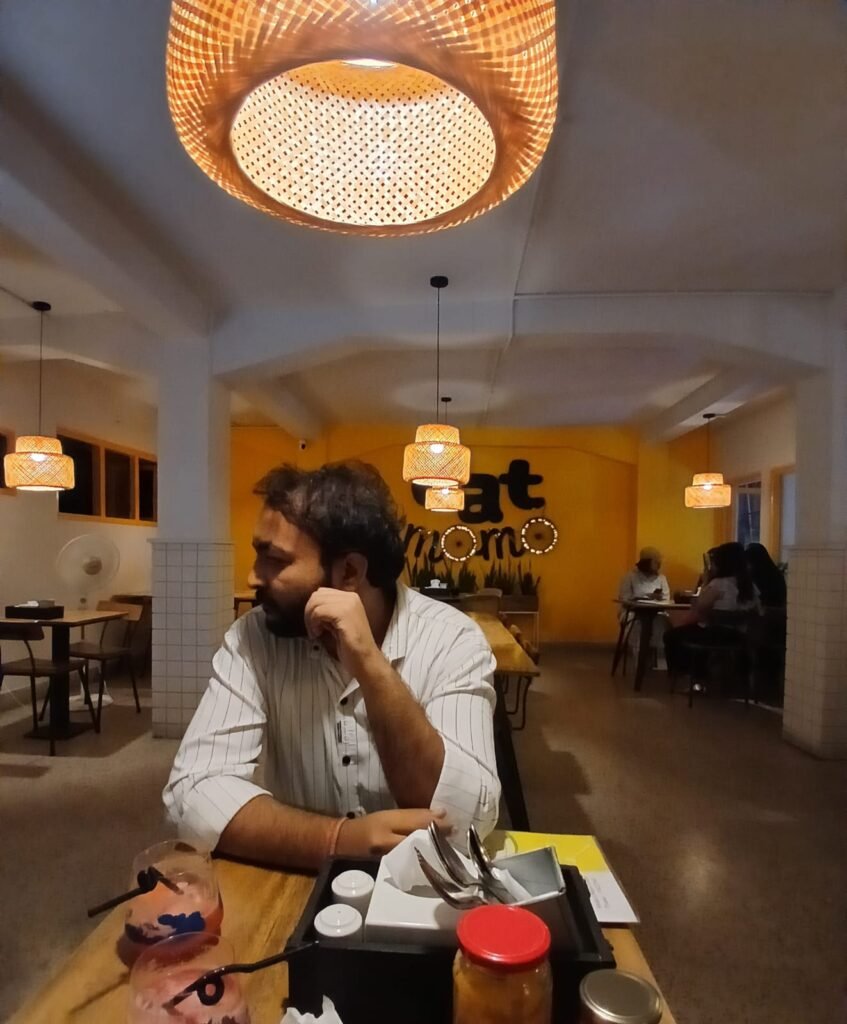
Food was another part of our overall travel experience, but we didn’t want to depend completely on hotel restaurants.
Pokhara gave us plenty of alternatives.
There were cafés and restaurants around Lakeside.
We could simply walk out and find something.
That gave us more choice.
Sometimes we wanted a proper meal.
Sometimes we wanted snacks.
Sometimes we wanted momos.
And sometimes we simply wanted a cold drink.
This is another reason why I liked staying in an area with restaurants nearby.
Our Late-Night Food Experience
One night after experiencing Pokhara’s nightlife, we became hungry.
Instead of returning immediately, we looked for somewhere that was still open.
We eventually found a café and ordered momos and a cold drink.
It was a simple meal.
But it became one of those little travel memories that I still remember.
And this is why I prefer staying somewhere with things around the hotel.
You never know when you’ll suddenly want food at night.
Hotel Staff Can Make a Difference
Our booking problem also taught me how important hotel staff can be.
When something goes wrong, that’s when you really see how a property handles customers.
In our case, the hotel owner helped us find another room nearby.
That made a frustrating situation much easier.
So when I look back at our hotel experience, I don’t only remember the room.
I remember how the problem was handled.
What I Would Check Before Booking a Hotel in Nepal
Based on our experience, I’d now check a few things more carefully.
1. Location
How far is the hotel from the area you actually want to explore?
2. Recent Reviews
Don’t rely only on old reviews.
Look at what recent guests are saying.
3. Room Type
Make sure the exact room you’re booking is actually available.
4. View
If a mountain or lake view matters to you, confirm it.
5. Check-In
Know the check-in timing before arriving.
6. Parking
This is particularly important if you’re renting a scooter.
We noticed at some tourist places that parking could be difficult, so this is something I’d consider more carefully.
7. Nearby Food
Having cafés and restaurants within walking distance can be extremely convenient.
Parking Is Something Scooter Travellers Should Think About
Because we explored Pokhara on a scooter, parking became something we had to think about.
At Paatal Lok, for example, there wasn’t really a proper dedicated parking space for bikes.
People were parking along the road.
That isn’t necessarily a hotel problem, but it made us realize how important parking can be when travelling with your own vehicle.
If you’re renting a scooter, I’d ask the hotel:
“Is parking available for the scooter?”
It sounds like a small question.
But it can save you trouble later.
Don’t Trust Hotel Photos Blindly
Online hotel photographs can look fantastic.
But photographs don’t always tell you everything.
A room can look spacious because of a wide-angle camera.
A “mountain view” might actually mean you can see a tiny portion of the mountains.
A property might look quiet during the day but be near a busy street at night.
That’s why reviews and location are important.
We learned this through experience.
What We Learned About Hotel Value
For our travel style, I’d define good hotel value as:
Comfort + location + reasonable price + helpful staff.
Luxury wasn’t necessary.
We weren’t looking for a swimming pool.
We weren’t looking for a huge lobby.
We didn’t need an expensive room.
We wanted somewhere that made the trip easier.
And that’s what I’d look for again.
Our Hotel Experience: What Worked and What Didn’t
| What Worked | What Could Have Been Better |
|---|---|
| Reasonable accommodation options | One room-booking issue |
| Convenient location | Room availability should have been confirmed |
| Helpful hotel owner | Online booking didn’t match the situation perfectly |
| Comfortable enough for our travel style | We would confirm important room features next time |
| Good access to nearby places | Parking should always be checked |
| Easy access to food and cafés | Better planning could reduce last-minute decisions |
Overall, the positive side outweighed the problems.
How Much Did Accommodation Cost Us?
Our overall Nepal trip expenditure was approximately ₹35,000–₹40,000, but we didn’t keep a precise separate record of every hotel payment.
So I don’t want to invent a fake hotel figure just to make this article look more complete.
The honest answer is:
Our accommodation costs were part of that overall ₹35,000–₹40,000 trip expenditure.
The exact hotel cost will also vary significantly depending on:
- Number of nights
- Room type
- Location
- Season
- Number of people
- Hotel category
- Whether breakfast is included
That’s why I think giving a made-up fixed hotel price would actually make the article less useful.
My Personal Hotel Checklist for Nepal
If I were travelling again, this would be my checklist:
| Check Before Booking | Importance |
|---|---|
| Location | ⭐⭐⭐⭐⭐ |
| Recent reviews | ⭐⭐⭐⭐⭐ |
| Room availability | ⭐⭐⭐⭐⭐ |
| Price | ⭐⭐⭐⭐ |
| View | ⭐⭐⭐⭐ |
| Parking | ⭐⭐⭐⭐ |
| Nearby restaurants | ⭐⭐⭐⭐ |
| Check-in timing | ⭐⭐⭐⭐ |
| Staff/service reviews | ⭐⭐⭐⭐ |
| Luxury facilities | ⭐⭐ |
Notice that luxury facilities are near the bottom.
That’s because they weren’t important to us.
Our priorities were completely different.
Would I Book Hotels Online Again?
Yes.
Definitely.
Online booking was useful for us.
It allowed us to compare properties and understand what was available before arriving.
I just wouldn’t stop there.
After booking, I’d contact the hotel directly for important details.
Especially if I had booked:
- A specific room
- A room with a view
- A particular number of guests
- A late check-in
- Scooter parking
That extra confirmation could make the experience smoother.
What I Learned From Our Hotel Experience
The biggest lesson is simple:
Don’t choose a hotel only because it looks beautiful online.
Think about how you’re actually going to travel.
If you’re going to spend all day outside, prioritize location and comfort.
If you’re travelling with a scooter, check parking.
If you want a mountain or lake view, confirm the exact room.
If you have a long journey before check-in, confirm your reservation.
And if something goes wrong, don’t immediately assume the whole stay is ruined.
Sometimes the way the hotel handles the problem matters more than the problem itself.
Final Thoughts
Our hotel experience in Nepal wasn’t perfect.
And honestly, I’m glad it wasn’t.
Because the booking issue taught us something that a perfect hotel stay never would have.
We learned to confirm reservations.
We learned that online photographs don’t tell the whole story.
We learned that location can be more valuable than luxury.
We learned that a helpful hotel owner can turn a frustrating situation into a manageable one.
And we learned that when you’re travelling around Nepal, your hotel doesn’t have to be the most expensive place in town.
It simply needs to work for your style of travel.
For us, that meant a reasonably priced, comfortable place where we could rest after exploring mountains, lakes, caves and the streets of Pokhara.
We spent our days outside.
We rode scooters.
We walked.
We explored.
We ate momos late at night.
We experienced nightlife.
We went into caves.
And eventually, we came back to the hotel and rested.
That’s what made the accommodation valuable to us.
Not luxury.
Not a huge room.
Just comfort, convenience and a place to recharge for the next day’s adventure.
And if I return to Nepal, I’ll use exactly the same philosophy—but I’ll make sure to confirm that room before I arrive.
Also see related article 3 Days in Pokhara: Our Real Itinerary, What We Did, What We Loved & What We Skipped, Pumdikot Pokhara by Scooter: Our Real Mountain Ride, Giant Shiva Statue & Unexpected Adventure, Our Nepal Trip From India: A Real Travel Story, From the Journey to the People We Met, Sarangkot Pokhara by Scooter: My Real Experience, Mountain Roads, Views & Paragliding, Paatal Lok Nepal Travel Experience (2026): My Adventurous Cave & Waterfall Experience