After exploring the spiritual atmosphere of Pashupatinath Temple, I wanted to experience another side of Kathmandu—its history, architecture and old-city atmosphere.
That is what made Kathmandu Durbar Square interesting for me.
Our Nepal trip had already taken us through very different experiences. We had enjoyed the peaceful side of Pokhara, travelled through mountain roads on a scooter, visited Sarangkot and Pumdikot, explored the narrow caves of Paatal Lok and experienced the nightlife around Lakeside.
Kathmandu Durbar Square felt different from all of those places.
Here, the attraction wasn’t one particular adventure.
It was the entire surroundings.
The old buildings.
The temples.
The traditional architecture.
The courtyards.
The people walking around.
And that feeling of being surrounded by a part of Nepal’s older history.
Kathmandu Durbar Square at a Glance
| Experience | My Take |
|---|---|
| Destination | Kathmandu Durbar Square |
| Location | Kathmandu, Nepal |
| Main attraction | Historic temples, palaces and traditional architecture |
| Architecture | ⭐⭐⭐⭐⭐ |
| Cultural experience | ⭐⭐⭐⭐⭐ |
| Photography | ⭐⭐⭐⭐⭐ |
| Spiritual atmosphere | ⭐⭐⭐⭐½ |
| Walking experience | ⭐⭐⭐⭐ |
| Adventure | ⭐⭐ |
| Overall experience | ⭐⭐⭐⭐⭐ |
These ratings are based on my personal experience, not an official ranking.
A Completely Different Side of Kathmandu
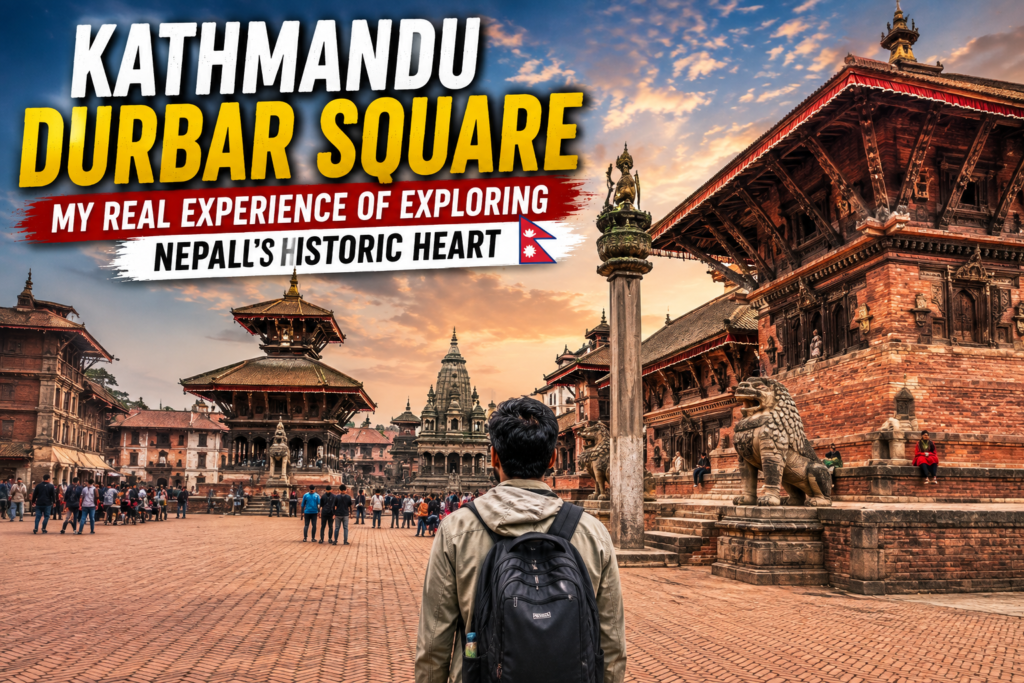
What I liked about Kathmandu Durbar Square was that it didn’t feel like a modern tourist attraction.
The surroundings have a very traditional character.
Instead of modern glass buildings and polished tourist infrastructure, you see old brick structures, carved wooden details, temples and traditional Nepali architecture.
You can walk around and keep discovering another building or another architectural detail.
And that’s what makes the place interesting.
You don’t necessarily need an activity.
You just need time to look around.
The Architecture Immediately Caught My Attention
The first thing that stood out to me was the architecture.
The buildings have a very distinctive appearance.
The combination of red brick, dark wooden elements, traditional roofs and detailed carvings gives the entire area a character that you don’t get from modern buildings.
For someone interested in travel photography, this is the kind of place where you can keep finding different frames.
You can photograph the larger structures.
Then you notice a small carving.
Then a doorway.
Then a roof.
Then a courtyard.
Everywhere you look, there is some architectural detail.
It Felt Like Walking Through Old Nepal
That’s probably the simplest way I can describe the feeling.
When you’re walking through Kathmandu Durbar Square, you don’t feel like you’re visiting a newly constructed attraction.
The surroundings make you think about how much history has passed through this area.
Even if you don’t know the complete history of every building, the environment itself communicates that this is an old and culturally important part of Kathmandu.
And for me, that was enough to make the visit memorable.
It’s Not Just One Building
One mistake would be to think of Kathmandu Durbar Square as a single monument.
The experience is much broader than that.
There are temples, palace structures, courtyards and traditional buildings spread throughout the area.
So rather than arriving, taking one photograph and leaving, I preferred walking around and looking at the different structures.
That also made the visit feel more natural.
We weren’t following a strict checklist.
We were simply exploring.
The Red-Brick Architecture Is Beautiful
One of the visual features I particularly liked was the use of red brick.
The colour gives the area a warm, historic appearance.
Combined with the traditional wooden carvings and roofs, it creates a very recognizable Nepalese look.
It’s also one of those places where photographs don’t always capture the full feeling.
In a photograph, you see a building.
When you’re standing there, you notice the scale, the surrounding sounds, the people and the other structures around it.
That’s the difference between seeing a place online and actually visiting it.
The Wooden Details Deserve Attention
Another thing I’d recommend is looking closely at the wooden architecture.
There are detailed carvings and traditional design elements that can easily be missed if you’re simply walking through.
I found myself looking upward and around rather than just walking straight ahead.
The roofs are interesting.
The windows are interesting.
The doors are interesting.
Even some of the smaller architectural elements add character.
For me, these details were a major part of the experience.
A Good Place for Photography
If you enjoy taking travel photographs, Kathmandu Durbar Square gives you plenty of material.
And I’m not talking only about photographs of yourself standing in front of a temple.
The location works well for different kinds of photographs:
- Wide architectural shots
- Temple details
- Wooden carvings
- Courtyards
- Roofs
- Brick buildings
- Street scenes
- People and everyday activity
- Close-up architectural details
The best photographs aren’t always the obvious ones.
Sometimes a small architectural detail tells more of the story than a large building.
The Atmosphere Was More Important Than the Checklist
This was something I noticed during our Nepal trip generally.
When you’re travelling, it’s easy to get obsessed with checking places off a list.
Visited. Done. Next.
But Kathmandu Durbar Square works better when you slow down.
Walk.
Look around.
Take photographs.
Observe the architecture.
Notice the people.
Then move on when you’re ready.
That’s how I prefer to experience historic places.
The Cultural Side of Kathmandu
Our trip had already introduced us to Nepal’s natural and adventurous side.
But Kathmandu Durbar Square brought us back to culture.
The architecture reflects traditions that are very different from what you see in modern cities.
And because the square is still part of the living city rather than an isolated museum, it feels more connected to everyday Kathmandu.
That’s something I appreciated.
You aren’t just looking at history behind glass.
You’re walking through a place that remains part of the city’s identity.
Comparing Kathmandu Durbar Square With Pashupatinath
I think these two destinations work very well together.
Pashupatinath gave us the spiritual side of Kathmandu.
Kathmandu Durbar Square gave us more of the historic and architectural side.
| Feature | Kathmandu Durbar Square | Pashupatinath |
|---|---|---|
| Main character | Historic & architectural | Spiritual & religious |
| Architecture | ⭐⭐⭐⭐⭐ | ⭐⭐⭐⭐⭐ |
| Spiritual atmosphere | ⭐⭐⭐⭐ | ⭐⭐⭐⭐⭐ |
| Photography | ⭐⭐⭐⭐⭐ | ⭐⭐⭐⭐ |
| Cultural experience | ⭐⭐⭐⭐⭐ | ⭐⭐⭐⭐⭐ |
| Walking & exploring | ⭐⭐⭐⭐⭐ | ⭐⭐⭐⭐ |
| Overall experience | ⭐⭐⭐⭐⭐ | ⭐⭐⭐⭐⭐ |
I wouldn’t choose one over the other.
If you’re visiting Kathmandu, experiencing both gives you a much broader understanding of the city.
What Made It Memorable for Me
For me, the most memorable part wasn’t one specific building.
It was the overall atmosphere.
You walk through the area and constantly see traditional architecture around you.
The brick buildings.
The temples.
The wooden details.
The courtyards.
The people.
The old-city feeling.
It creates an atmosphere that’s difficult to reproduce somewhere else.
And that’s exactly what I look for when travelling.
I don’t necessarily need an attraction to be thrilling.
Sometimes I just want it to feel different from home.
Kathmandu Durbar Square definitely did that.
It Was a Nice Change From Our Mountain Experiences
This was also important for our Nepal itinerary.
Before this, we’d spent a lot of time around Pokhara.
We had been riding scooters.
We’d travelled through mountain roads.
We had gone to Sarangkot.
We had visited Pumdikot.
We had explored Paatal Lok.
Those experiences were very different.
Kathmandu Durbar Square slowed the trip down again.
Instead of looking at mountains, we were looking at architecture.
Instead of thinking about the road ahead, we were looking at what was around us.
That variety made the overall trip much better.
What I Enjoyed Most
If I had to choose the best parts of our Kathmandu Durbar Square experience, I’d rank them like this.
1. Traditional Architecture — 5/5
The combination of brick, wood, roofs and carvings was beautiful.
2. Cultural Atmosphere — 5/5
It felt connected to Nepal’s history and identity.
3. Photography — 5/5
There were countless interesting details to photograph.
4. Exploring on Foot — 4.5/5
Walking around allowed us to discover things naturally.
5. Overall Atmosphere — 5/5
The old-city character made it memorable.
What Could Have Been Better?
Since this is supposed to be an honest travel experience, I don’t want to make it sound perfect.
Historic city-centre attractions can obviously become busy.
And when there are lots of visitors around, it can sometimes be harder to properly appreciate the architecture.
You may have to wait for people to move before getting the photograph you want.
You also can’t expect every part of a historic site to look like a perfectly preserved postcard.
That’s part of the reality of visiting old places.
But for me, those imperfections didn’t take away from the experience.
In some ways, they made it feel more real.
Don’t Rush Through the Square
If you’re visiting Kathmandu Durbar Square, I’d recommend giving yourself enough time to walk around.
Don’t arrive with the mindset:
“I have 20 minutes, let’s take photographs and leave.”
You’ll probably miss a lot.
Look at the smaller details.
Walk through different sections.
Look at the roofs.
Look at the windows.
Look at the carvings.
Watch how people interact with the space.
That’s where the experience becomes more interesting.
The Best Part Was Discovering Details Unexpectedly
One of my favourite things about historic places is that you don’t always know what you’ll see next.
You turn a corner and there’s another structure.
You look upward and notice an interesting roof.
You walk into another courtyard and see completely different architecture.
That’s what happened here.
It wasn’t about one giant moment.
It was a series of small discoveries.
And those little discoveries are what make walking through historic areas enjoyable.
Kathmandu Durbar Square as a Travel Photography Destination
If you’re creating travel content, this is a particularly useful place.
You can create different types of content from one visit.
For example:
Architecture: Traditional temples and buildings.
Culture: People and the atmosphere.
History: The old structures and courtyards.
Photography: Details, wide shots and portraits.
Travel story: Your personal reaction to the place.
That’s also why I think Kathmandu Durbar Square fits naturally into our Nepal travel series.
It’s not just another destination.
It gives us a different story to tell.
My Personal Experience vs What You See Online
Online, Kathmandu Durbar Square can look like a collection of beautiful buildings.
And yes, it is beautiful.
But standing there changes the experience.
You understand the scale.
You notice the sounds.
You see people moving around.
You see how the old structures sit within the modern city.
You realize that the square isn’t simply a photograph.
It’s a living environment.
That’s something you can’t completely understand from a screen.
How It Fits Into a Kathmandu Trip
If I were planning our trip again, I’d combine Kathmandu Durbar Square with other cultural experiences rather than trying to make it the only destination of the day.
For example:
Morning: Historic sightseeing
Afternoon: Explore another Kathmandu attraction
Evening: Food and local streets
That gives you variety.
And because Kathmandu has so much cultural history, you can spend the day exploring different sides of the city.
Kathmandu Durbar Square vs Pokhara
The difference between Kathmandu and Pokhara became very clear during our trip.
| Kathmandu | Pokhara |
|---|---|
| Historic architecture | Mountains and lake |
| Temples and heritage | Nature and viewpoints |
| Busy city atmosphere | More relaxed tourist atmosphere |
| Cultural exploration | Outdoor exploration |
| Historic squares | Phewa Lake & Lakeside |
| Traditional architecture | Mountain roads |
That’s why I wouldn’t recommend choosing only one.
They complement each other.
Pokhara gives you the natural beauty.
Kathmandu gives you the cultural and historical depth.
My Overall Rating
If I look at Kathmandu Durbar Square purely from my experience, I’d give it:
5/5
Not because everything was perfect.
But because it gave us something we hadn’t experienced in the same way elsewhere during the trip.
The architecture was impressive.
The atmosphere was distinctive.
There was plenty to explore.
And most importantly, it helped us experience another side of Nepal.
Final Thoughts
Our Nepal trip wasn’t built around one particular type of destination.
That’s what made it special.
We experienced mountains.
We experienced lakes.
We experienced adventure.
We experienced nightlife.
We experienced caves.
We experienced spirituality.
And with Kathmandu Durbar Square, we experienced history and architecture.
Walking through the square gave us a completely different feeling from riding a scooter around Pokhara or squeezing through the narrow passages of Paatal Lok.
There was no adrenaline.
There was no mountain road.
There was no waterfall.
Instead, there were old buildings, temples, brick walls, wooden details and the atmosphere of historic Kathmandu.
And honestly, I enjoyed that change of pace.
For me, the best way to experience Kathmandu Durbar Square isn’t to treat it as another item on a tourist checklist.
Walk slowly.
Look around.
Notice the architecture.
Take photographs.
And allow yourself to simply absorb the atmosphere.
Because when you travel somewhere like Nepal, the destination isn’t always about doing something exciting.
Sometimes it’s about standing in an old square, looking at the buildings around you and realizing that you’re surrounded by a piece of history.
That was my experience of Kathmandu Durbar Square—and that’s why I think it deserves a place in any Nepal trip that wants to experience more than just mountains and viewpoints.
Also see related article Exploring Pokhara by Scooter: Our Real Mountain Road Experience in Nepal, Things I Wish I Knew Before Visiting Nepal From India: My Real Travel Lessons, Pashupatinath Temple, Kathmandu: My Real Experience of Nepal’s Spiritual Side