Our Total Nepal Trip Expenditure
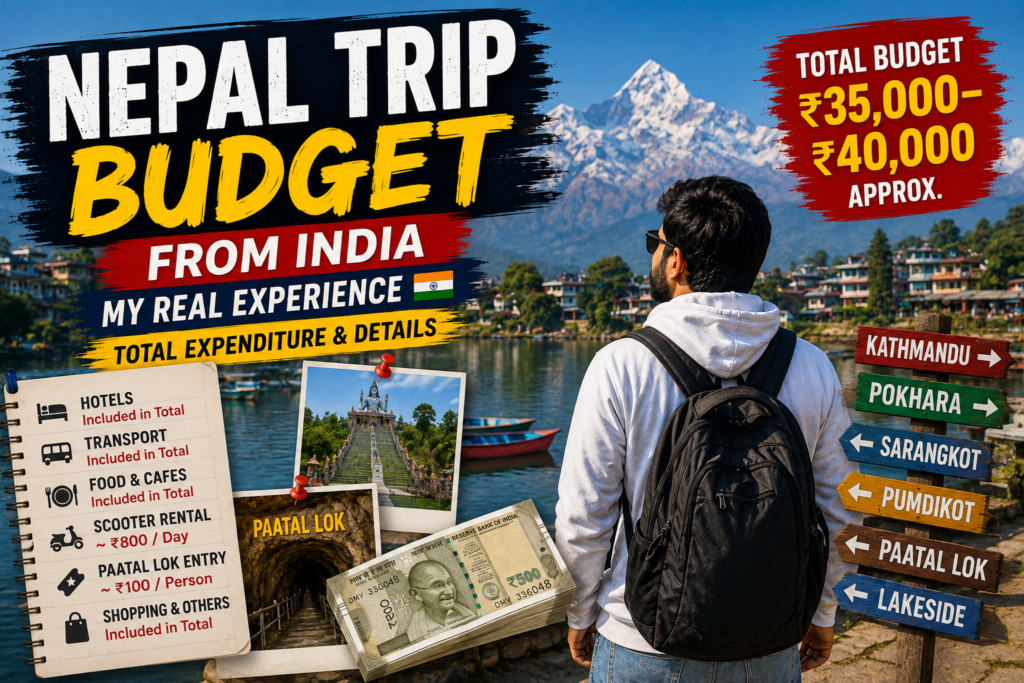
Our overall Nepal trip cost came to approximately ₹35,000–₹40,000. The amount included our travel, accommodation, food, local transportation, sightseeing and other expenses during the trip.
| Expense Category | Our Experience / Approximate Cost |
|---|---|
| Total Trip Expenditure | ₹35,000–₹40,000 |
| Hotels & Accommodation | Included in total |
| Intercity & Local Transport | Included in total; varied by distance and negotiation |
| Food & Cafés | Included in total |
| Scooter Rental | Around ₹800/day |
| Paatal Lok Entry | Around ₹100/person |
| Shopping & Souvenirs | Included in total |
| Nightlife | Included in total |
| Other Travel Expenses | Included in total |
A Note About Our Budget
The ₹35,000–₹40,000 figure is our actual approximate overall expenditure, rather than a fixed package price. Some individual expenses changed depending on distance, negotiation and what we chose to do.
For example, our scooter rental was around ₹800 for the day, while the Paatal Lok entry ticket was approximately ₹100 per person.
So if you’re planning your own Nepal trip, don’t treat ₹35,000–₹40,000 as a guaranteed price. Your final expenditure will depend on your number of days, accommodation, transport, food and activities.
When we started planning our Nepal trip, one of the biggest questions was obviously the budget.
How much money would we actually need?
Would travelling around Nepal be expensive?
How much would we spend on hotels, transport, food and sightseeing?
And most importantly, could we comfortably complete the trip without spending a huge amount?
After completing the trip, our overall expenditure came to around ₹35,000–₹40,000.
That was our approximate total for the trip, including our travel and other expenses.
But what I realized during the journey was that your Nepal budget can change quite a lot depending on how you travel, where you stay, how much you negotiate and how many activities you choose.
So, rather than giving you some generic internet estimate, this article is about our actual Nepal travel experience and the kind of expenses we encountered along the way.
Our Nepal Trip Was Not a Luxury Trip
First, let me make one thing clear.
We weren’t travelling on an expensive luxury package.
Our trip was more about experiencing Nepal than spending money on luxury.
We explored places ourselves, used local transport, stayed in reasonably priced hotels and made decisions along the way.
Sometimes we booked things online.
Sometimes we asked people.
Sometimes we simply reached a place and figured things out there.
That made the trip much more flexible.
And because we weren’t following a luxury travel style, our total expenditure remained around the ₹35,000–₹40,000 range.
Our Approximate Total Budget
Our total expenditure for the trip was approximately:
₹35,000–₹40,000
This was the overall amount we spent on our Nepal journey.
However, I don’t want to present a completely made-up expense breakdown just to make the numbers look precise.
Some expenses were shared, some varied depending on the distance, and some were negotiated.
So the ₹35,000–₹40,000 figure is the more useful representation of our actual experience.
Your own budget can be lower or higher depending on your travel style.
Transport Was a Major Part of the Journey
Transport was obviously one of the most important parts of our Nepal trip.
We travelled between different places and also used local transport once we were there.
One thing we quickly understood was that city-to-city travel prices can vary.
Distance matters.
But negotiation can also matter.
So if you’re travelling around Nepal independently, don’t assume that the first price you hear is automatically the final price.
We learned to ask about the price first and then negotiate where appropriate.
Negotiation Can Save You Money
This was particularly useful for us because we were travelling independently.
There were situations where prices could vary depending on the distance and the person providing the transport.
So we didn’t simply accept every price immediately.
We asked.
We compared when possible.
And we negotiated.
You don’t have to turn every transaction into an argument.
Just ask politely whether the price can be reduced.
That small habit can make a difference over the course of a trip.
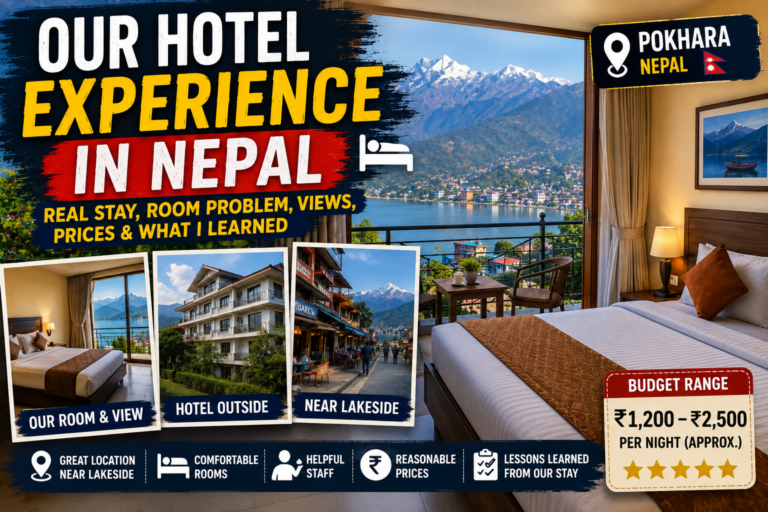
Hotels Were Reasonably Priced for Us
Accommodation was another important part of the budget.
During our trip, we found that hotels could be available at reasonable prices, especially if you weren’t looking for luxury accommodation.
We also checked hotels online.
That made it easier to compare different options before deciding where to stay.
In Pokhara, for example, we wanted a place where we could actually enjoy the surroundings.
The view became important to us.
And that was one of the things we noticed during the trip: sometimes paying a little attention to the location of your hotel can improve the entire experience.
Our Hotel Experience Wasn’t Always Perfect
Of course, travelling on a budget doesn’t mean everything goes perfectly.
We had a situation where the room we had originally booked wasn’t available when we arrived.
We had specifically wanted a room with a view.
Fortunately, the hotel owner helped us arrange another room nearby.
It wasn’t exactly what we had originally planned, but we managed.
That’s another reason I don’t like presenting travel budgets as if everything is perfectly predictable.
Real trips don’t work that way.
Sometimes your booking works perfectly.
Sometimes there is a problem.
And you have to figure it out.
Paatal Lok Was One of the Cheapest Adventures
One of our most memorable experiences was Paatal Lok.
And interestingly, it wasn’t an expensive activity.
The ticket we paid was approximately:
₹100 per person
For that amount, we got an experience that became one of the most adventurous memories of our Nepal trip.
We went down through the spiral staircase and eventually entered the caves.
The passages became extremely narrow.
There were sections where I had to bend down because I’m around 5’10” and the ceiling was too low.
There were also lots of people inside.
Water was dripping from the cave ceiling.
And at some points, the passages were so narrow that only one or two people could move comfortably.
For us, that was an experience far more memorable than its price would suggest.
Not Every Great Experience Needs to Be Expensive
That’s something I learned from this trip.
Sometimes you think that the most expensive activity will automatically be the most memorable.
Not necessarily.
Paatal Lok cost us around ₹100 per person, yet it became one of the experiences we talked about the most.
The adventure came from the environment itself.
The narrow caves.
The darkness.
The water.
The crowds.
The uncertainty of what we’d find further inside.
That was enough.
Exploring Pokhara Without Spending Constantly
Pokhara was another place where we realized you don’t have to spend money every minute.
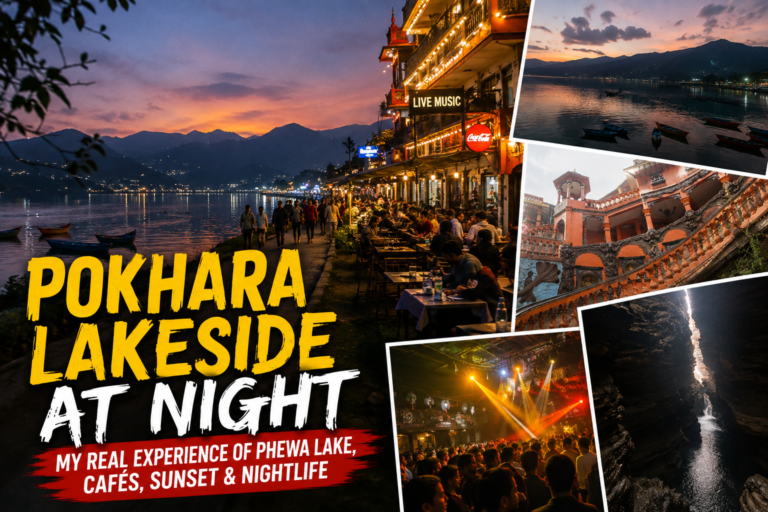
We spent time around Phewa Lake and Lakeside.
We walked around.
We explored cafés.
We listened to live music.
We watched the surroundings.
And sometimes simply sitting somewhere and enjoying the atmosphere was enough.
You don’t necessarily need to book an expensive activity every few hours to enjoy a destination.
Sometimes the best part is simply being there.
Cafés and Food
Food was obviously another part of our daily spending.
We ate at different places during the trip and explored cafés around Pokhara.
One of the things we liked about Lakeside was the variety.
You could find different types of places to eat and choose according to your budget.
One night, after experiencing the nightlife, we were hungry and found a café that was still open.
We ordered momos and a cold drink.
It was a simple meal, but after being out late, it tasted perfect.
That’s another thing about travel:
The best food isn’t always the most expensive food.
Sometimes it’s the plate of momos you find when you’re tired and hungry at the end of the night.
Renting a Scooter and Exploring Around Pokhara
Having a scooter made our Pokhara experience much more flexible.
Instead of depending completely on other forms of transport, we could travel around on our own.
That allowed us to explore places like Sarangkot and Pumdikot.
The mountain roads became part of the adventure.
We could stop when we wanted.
We could take photographs.
We could enjoy the scenery.
And we could change our plans depending on the weather.
For me, this was one of the best parts of exploring Pokhara.
Sarangkot Was More Than Just a Destination
Our Sarangkot experience wasn’t just about reaching a viewpoint.
The journey itself was memorable.
We travelled through the mountain roads and saw the landscape changing as we went higher.
At Sarangkot, we explored the temple area and enjoyed the views.
We also saw people paragliding.
We didn’t do the activity ourselves, but watching the paragliders was still exciting.
The weather wasn’t always perfect, so the views weren’t always as clear as we had hoped.
But we still enjoyed the experience.
Pumdikot and the Shiva Statue
Pumdikot was another place we explored around Pokhara.
The giant Shiva statue immediately stood out.
The mountain setting made the entire place feel even more impressive.
We spent time there, took photographs and explored the surrounding area.
Again, it wasn’t about spending huge amounts of money.
It was about getting there and experiencing the place.
The scooter ride, the mountain roads and the destination all became part of the memory.
Indian Currency Made Things Convenient
As Indian travellers, another thing that was convenient for us was the use of Indian currency during our experience.
It made some everyday transactions simpler.
We didn’t have to worry about converting every small amount of money.
However, I would still recommend checking the current currency and payment situation before travelling because rules and acceptance can change.
I’m talking here specifically about what we experienced during our trip.
The Importance of Bargaining
If you’re travelling independently, I would definitely keep bargaining in mind.
We noticed that prices for some things could depend on distance and negotiation.
So don’t be afraid to ask:
“Bhai, thoda kam ho jayega?”
Sometimes the answer will be no.
That’s fine.
But if you don’t ask, you’ll never know.
The important thing is to negotiate respectfully rather than treating every transaction like a fight.
Our Biggest Expense Wasn’t Always Money
This sounds strange, but I think the biggest cost of our trip wasn’t necessarily financial.
It was time and energy.
We travelled long distances.
We spent hours on buses.
We travelled through mountain roads.
We walked through narrow caves.
We dealt with crowds.
We searched for hotels.
We figured out transportation.
We changed plans because of weather.
All of that takes energy.
That’s why I think a realistic travel budget should include more than just money.
You also need to budget your time and your energy.
Our Return Journey to Delhi
Eventually, it was time to return to India.
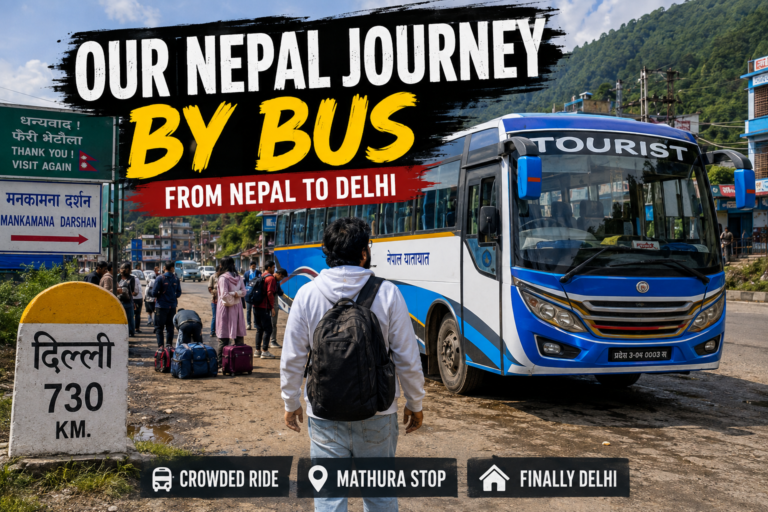
We travelled by bus towards Delhi.
The bus was crowded and almost all the seats were occupied.
We managed to sit towards the back.
During the journey, we spoke with people around us and took their help whenever we needed to understand the route.
The bus eventually stopped at Mathura, where we got out and had breakfast.
After continuing the journey, we finally reached Delhi in the afternoon.
We dropped our friends at their homes and then finally returned to our own home.
Was ₹35,000–₹40,000 Worth It?
For me, absolutely.
When I think about what we experienced within that overall budget, I feel that we got a lot out of the trip.
We explored cities.
We travelled through mountains.
We stayed in hotels.
We rented a scooter.
We visited religious places.
We explored caves.
We spent time around a lake.
We experienced cafés and nightlife.
We met people.
We travelled long distances.
And most importantly, we came back with memories.
The exact amount of money isn’t what I remember.
I remember the experiences.
How Much Should You Budget for Your Own Nepal Trip?
If you’re planning a Nepal trip after reading about our experience, I wouldn’t simply copy our ₹35,000–₹40,000 budget and assume you’ll spend exactly the same.
Your trip could be completely different.
It depends on:
- Number of days
- Number of travellers
- Hotel type
- Transport choices
- Food
- Shopping
- Activities
- Negotiation
- Places you visit
- Whether you rent a vehicle
Our figure should be treated as a real-world reference from our trip, not a fixed Nepal travel price.
My Biggest Budget Travel Lesson From Nepal
The biggest lesson I learned was that you don’t have to spend heavily to create memorable experiences.
Some of our favourite moments cost very little.
Sometimes we were simply walking around.
Sometimes we were sitting beside Phewa Lake.
Sometimes we were talking to people.
Sometimes we were riding a scooter through the mountains.
And sometimes we were exploring a cave after paying around ₹100 for entry.
The value of an experience isn’t always connected to its price.
Final Thoughts
Our Nepal trip cost us approximately ₹35,000–₹40,000 overall, but the number itself doesn’t really tell the story.
The real story is what we got for that money.
We travelled through Nepal without a perfectly fixed itinerary.
We negotiated.
We asked people for help.
We stayed in reasonably priced hotels.
We explored Pokhara by scooter.
We visited Sarangkot and Pumdikot.
We went deep inside Paatal Lok.
We spent evenings around Phewa Lake.
We explored cafés and nightlife.
And finally, we took the long bus journey back to Delhi.
There were comfortable moments.
There were tiring moments.
There were moments when we were nervous.
There were moments when the weather ruined our plans.
And there were moments when we simply stopped and thought:
“This is exactly why we travel.”
So if you’re wondering whether a Nepal trip from India can be done within a reasonable budget, our experience says yes.
Just don’t focus only on the money.
Plan your essentials, keep some flexibility, negotiate where appropriate, and leave enough room for unexpected experiences.
Because our best memories from Nepal weren’t necessarily the expensive ones.
They were the moments we didn’t plan at all.
Our ₹35,000–₹40,000 Nepal trip wasn’t just an expenditure. It became a collection of memories that we’ll probably remember for much longer than the money we spent.
Also See Related Article Paatal Lok Nepal Travel Experience (2026): My Adventurous Cave & Waterfall Experience, Sarangkot Pokhara by Scooter: My Real Experience, Mountain Roads, Views & Paragliding, Our Nepal Trip From India: A Real Travel Story, From the Journey to the People We Met, India to Nepal by Bus (2026): My Completely Unplanned 7-Day Trip from Delhi to Kathmandu & Pokhara, Pumdikot Pokhara by Scooter: Our Real Mountain Ride, Giant Shiva Statue & Unexpected Adventure